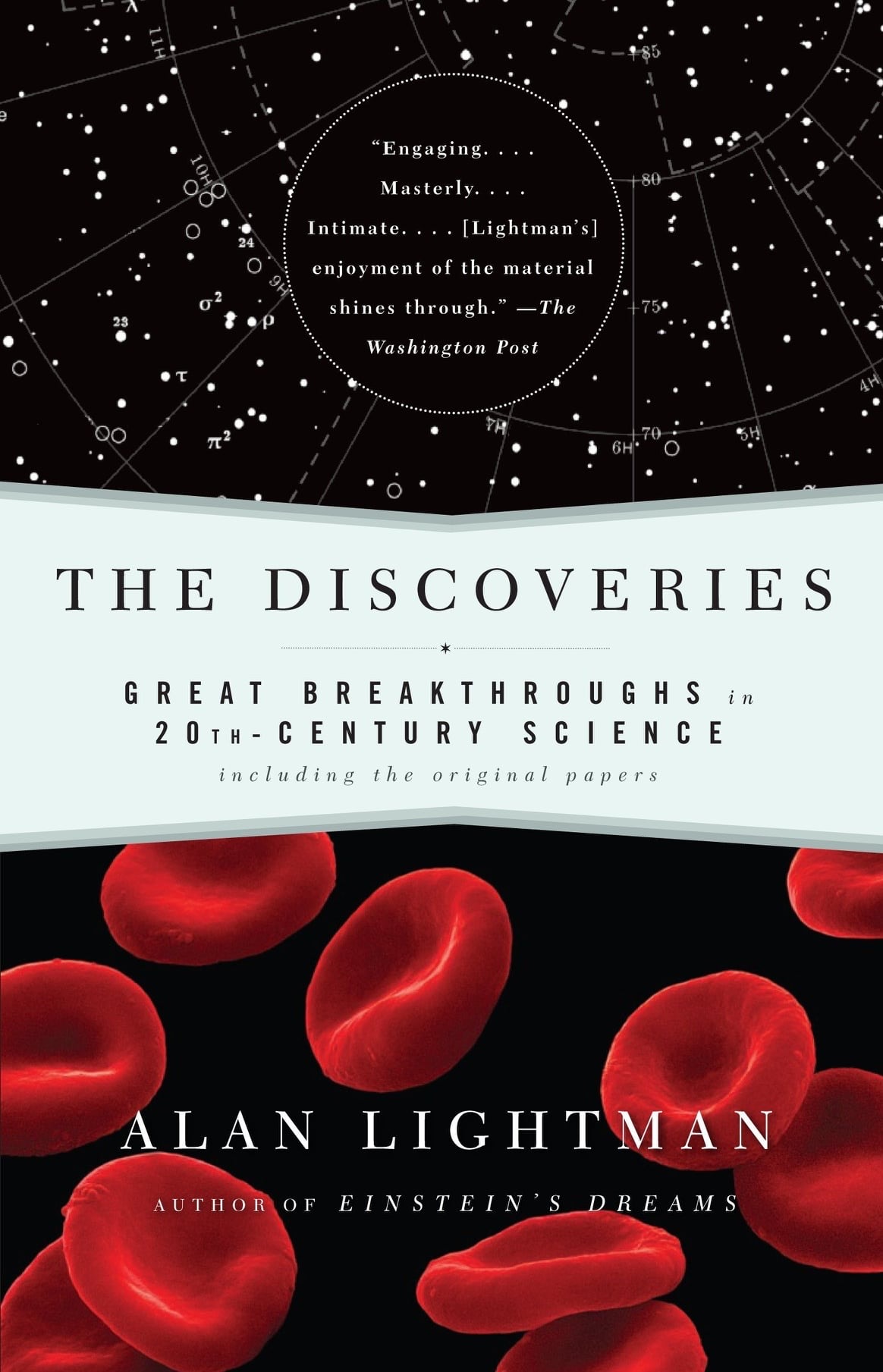
The Discoveries
Great Breakthroughs in 20th-Century Science, Including the Original Papers,
by Alan Lightman
all references via https://en.wikipedia.org/wiki/Alan_Lightman unless otherwise noted
I received this book as a gift from my grandfather when I was around college age. He had excellent taste in books, among other things. He was a medical doctor with well-developed intellectual passions outside of medicine. They included mathematics, computing, and philosophy.
Each chapter is a different breakthrough scientific paper from the 20th century, as well as commentary on it.
Alan Lightman is distinctive in being both a fully qualified professor of astrophysics as well as a highly accomplished writer. He received degrees in physics from Princeton University (A.B.) and Caltech (Ph.D). In the latter, he studied under the now Nobel laureate astrophysicist Kip Thorne.
As a writer, apart from “The Discoveries”, he wrote the international bestseller “Einstein’s Dreams” and the National Book Award finalist “The Diagnosis”. He’s a professor of both astrophysics and the humanities, one of the first people at MIT to receive such a joint appointment. Almost impossibly, he’s a real-deal scientist, having published important astrophysical research papers in journals including Physical Review and Nature.
At MIT, he’s led an initiative to help grow students’ communication skills to match their technical skills:
“He played a major role in establishing MIT’s “Communication Requirement,” which requires all undergraduates to receive training each of their four years in writing and speaking.”
Some chapters I particularly liked, with the original scientific paper, author, and date below the chapter title:
-
A Unified Theory of Forces
"A Model of Leptons", by Steven Weinberg (1967) -
The Movability of Genes
"Mutable Loci in Maize", by Barbara McClintock (1948) -
The Uncertainty Principle
"On the Physical Content of Quantum Kinematics and Mechanics", Werner Heisenberg (1927)
Interesting fact: The Heisenberg uncertainty principle is the reason one can't predict the future (with 100% accuracy) using physics. When introduced in 1928, it settled the millenia-old philosophical debate over whether it's possible to use the past/present to predict the future. - The Chemical Bond "The Shared-Electron Chemical Bond", by Linus Pauling (1928)
Below is the full list of chapters. Excellent selection and coverage.
-
THE QUANTUM —“On the Theory of the Energy Distribution Law of the Normal Spectrum,” by Max Planck (1900)
-
HORMONES —“The Mechanism of Pancreatic Secretion,” by William Bayliss and Ernest Starling (1902)
-
THE PARTICLE NATURE OF LIGHT —“On a Heuristic Point of View Concerning the Production and Transformation of Light,” by Albert Einstein (1905)
-
SPECIAL RELATIVITY —“On the Electrodynamics of Moving Bodies,” by Albert Einstein (1905)
-
THE NUCLEUS OF THE ATOM —“The Scattering of alpha and beta Particles by Matter and the Structure of the Atom,” by Ernest Rutherford (1911)
-
THE SIZE OF THE COSMOS —“Periods of 25 Variable Stars in the Small Magellanic Cloud,” by Henrietta Leavitt (1912)
-
THE ARRANGEMENT OF ATOMS IN SOLID MATTER —“Interference Phenomena with Röntgen Rays,” by W. Friedrich, P. Knipping, and M. von Laue (1912)
-
THE QUANTUM ATOM —“On the Constitution of Atoms and Molecules,” by Niels Bohr (1913)
-
THE MEANS OF COMMUNICATION BETWEEN NERVES —“On the Humoral Transmission of the Action of the Cardiac Nerve,” by Otto Loewi (1921)
-
THE UNCERTAINTY PRINCIPLE —“On the Physical Content of Quantum Kinematics and Mechanics,” Werner Heisenberg (1927)
-
THE CHEMICAL BOND —“The Shared-Electron Chemical Bond,” by Linus Pauling (1928)
-
THE EXPANSION OF THE UNIVERSE —“A Relation Between Distance and Radial Velocity Among Extra-Galactic Nebulae,” by Edwin Hubble (1929)
-
ANTIBIOTICS —“On the Antibacterial Action of Cultures of Penicillium, with Special Reference to Their Use in the Isolation of B. Influenzae,” by Alexander Fleming (1929)
-
THE MEANS OF PRODUCTION OF ENERGY IN LIVING ORGANISMS —“The Role of Citric Acid in Intermediate Metabolism in Animal Tissues,” by Hans Krebs and W. A. Johnson (1937)
-
NUCLEAR FISSION —“Concerning the Existence of Alkaline Earth Metals Resulting from Neutron Irradiation of Uranium,” by Otto Hahn and Fritz Strassmann (1939) and —“Disintegration of Uranium by Neutrons: A New Type of Nuclear Reaction,” by Lise Meitner and Otto Frisch (1939)
-
THE MOVABILITY OF GENES —“Mutable Loci in Maize,” Barbara McClintock (1948)
-
THE STRUCTURE OF DNA —“Molecular Structure of Nucleic Acids,” by James D. Watson and Francis H. C. Crick (1953) and —“Molecular Configuration in Sodium Thymonucleate,” by Rosalind E. Franklin and R. G. Gosling (1953)
-
THE STRUCTURE OF PROTEINS —“Structure of Hæmoglobin,” by Max F. Perutz, M. G. Rossmann, Ann F. Cullis, Hilary Muirhead, Georg Will, and A. C. T. North (1960)
-
RADIO WAVES FROM THE BIG BANG —“A Measurement of Excess Antenna Temperature at 4080 Mc/s,” by Arno A. Penzias and Robert W. Wilson and —“Cosmic Black-Body Radiation,” by Robert H. Dicke, P. James E. Peebles, Peter G. Roll, and David T. Wilkinson (1965)
-
A UNIFIED THEORY OF FORCES —“A Model of Leptons,”” by Steven Weinberg (1967)
-
QUARKS: A TINIEST ESSENCE OF MATTER —“Observed Behavior of Highly Inelastic Electron-Proton Scattering,” by M. Breidenbach, J. I. Friedman, H. W. Kendall, E. D. Bloom, D. H. Coward, H. DeStaebler, J. Drees, L. W. Mo, and R. E. Taylor (1969)
-
THE CREATION OF ALTERED FORMS OF LIFE —“Biochemical Method of Inserting New Genetic Information into DNA of Simian Virus 40,” by David A. Jackson, Robert H. Symons, and Paul Berg (1972)
Source: https://penguinrandomhousehighereducation.com/book/?isbn=9780307483843