The Most Important Thing in The World
"The most important thing in the world is culture,
because only with a good culture can we enjoy all of the good things that are available to us"

I often come back to a conversation I heard years ago, between Dr. Joscha Bach, a German cognitive scientist, and the artificial intelligence model GPT-3. Dr. Bach prompted GPT-3 to answer as though it were Johann Wolfgang von Goethe, the famous 18th and 19th century German intellectual.
Bach:
"The world is full of good things, and we can't experience them all. We have to choose a few, and the problem is that we chose the wrong ones. But then again, it's not our fault: we had no other choice."
GPT-3 as Goethe:
"What can we do about it? We can only change the culture."
Bach:
"Johann, I agree. The most important thing in the world is culture, because only with a good culture can we enjoy all of the good things that are available to us."
GPT-3 as Goethe:
"Then let's begin to create a new culture."²
Click the image below to watch the whole conversation (about 4.5 minutes)

Culture is the key
I used to think technological innovation is the key to a better society. If we made a better microchip or a new medicine, things would be good.
Technology is of course important. Only one thing has inflected the curve of human prosperity: the invention of the first commercially successful steam engine, in 1712³.
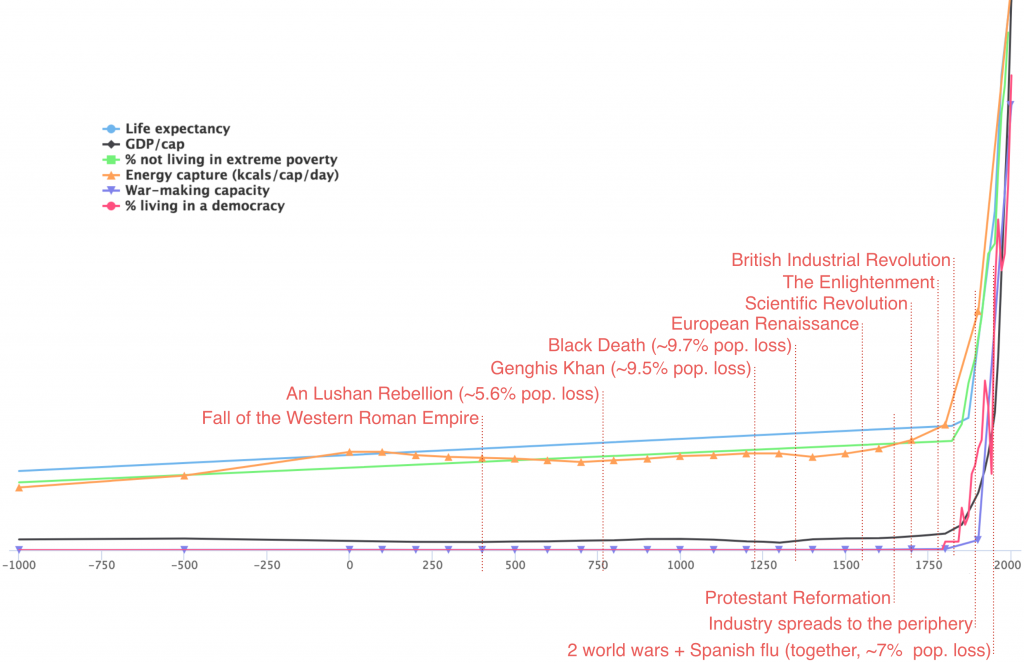
Later in life, I decided that technology is necessary, but not sufficient. This essay explains why.
Green Mountain Care
In March of 2011, the state of Vermont in the United States passed bill H.202, legislating a completely government-funded universal healthcare system for Vermont residents.⁵ The system was called "Green Mountain Care", after Vermont's nickname: "The Green Mountain State".
"As of January 2013, Vermont was still working out the role of Green Mountain Care and the responsibilities of the bill, as well as how to fund the program."⁵
A year later, the bill was dead.
"As of April 2014, Vermont had yet to craft a bill that would address the $2 billion in extra spending necessary to fund the single-payer system, and by the end of the year, the state abandoned their plan for universal health care, citing the taxes required of smaller businesses within the state."⁵
The failure of Green Mountain Care happened in the wealthiest country in the world. Also, in 2014 Vermont was in the top third of states for GDP per capita⁶, and had a relatively high state income tax rate⁷. Finally, there was clearly significant political will, or the bill wouldn't have materialized in the first place. So what was the problem?
I believe the problem was entirely cultural. The problem wasn't logistical, economic, or even political.
In particular, the United States is quite culturally individualistic. Paying for someone else's healthcare isn't individualistic.
I should note that individualism isn't the same as selfishness. It's more complicated than that. "Per capita, Americans voluntarily donate [to charity] about seven times as much as continental Europeans. Even our cousins the Canadians give to charity at substantially lower rates, and at half the total volume of an American household."⁸
"A people can never choose between different types of government. It can choose the outer trappings of government, but not the essential thing, the spirit of government—even though public opinion constantly confuses the two. What gets written into a constitution is never essential. The important thing is how the instinct of the people interprets it."
―Oswald Spengler, Prussianism and Socialism⁹
What is culture?
Between 1967 and 1973, Dutch social psychologist Geert Hofstede surveyed 117,000 IBM employees across 50 countries, asking them questions to understand their worldviews. The result was "Hofstede's cultural dimensions theory". His theory assigns each country a score for each of 6 "cultural dimensions", such as the dimension of individualism versus collectivism¹⁰.
These are his findings for a few countries¹¹:
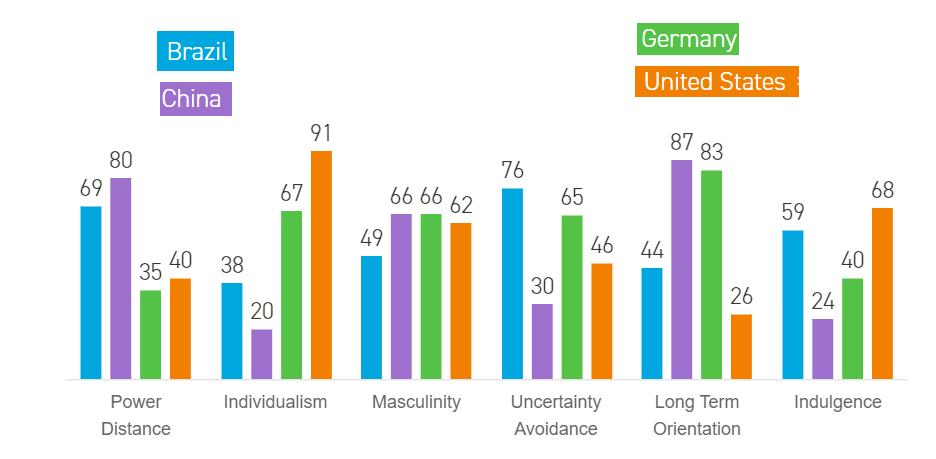
As you can see, the United States has a score of 91 in the "individualism" dimension. The graph only shows 4 countries, but in Hofstede's full analysis, the United States still scores the highest in the entire world in individualism.¹²
Culture isn't just a phenomenon of nations. There's a culture to every town, school, and interpersonal relationship.
Culture is often ostensibly consequentialist: "fermented food is good for you".
While it can have consequentialist ramifications, such as universal healthcare, it's fundamentally deontological: "this food reminds me of my childhood"
Culture is often framed through externalities: language, religion, rituals. It's really like air, though: so fundamental, when you're born into it, that you don't even notice it.
“The most important thing in the world”
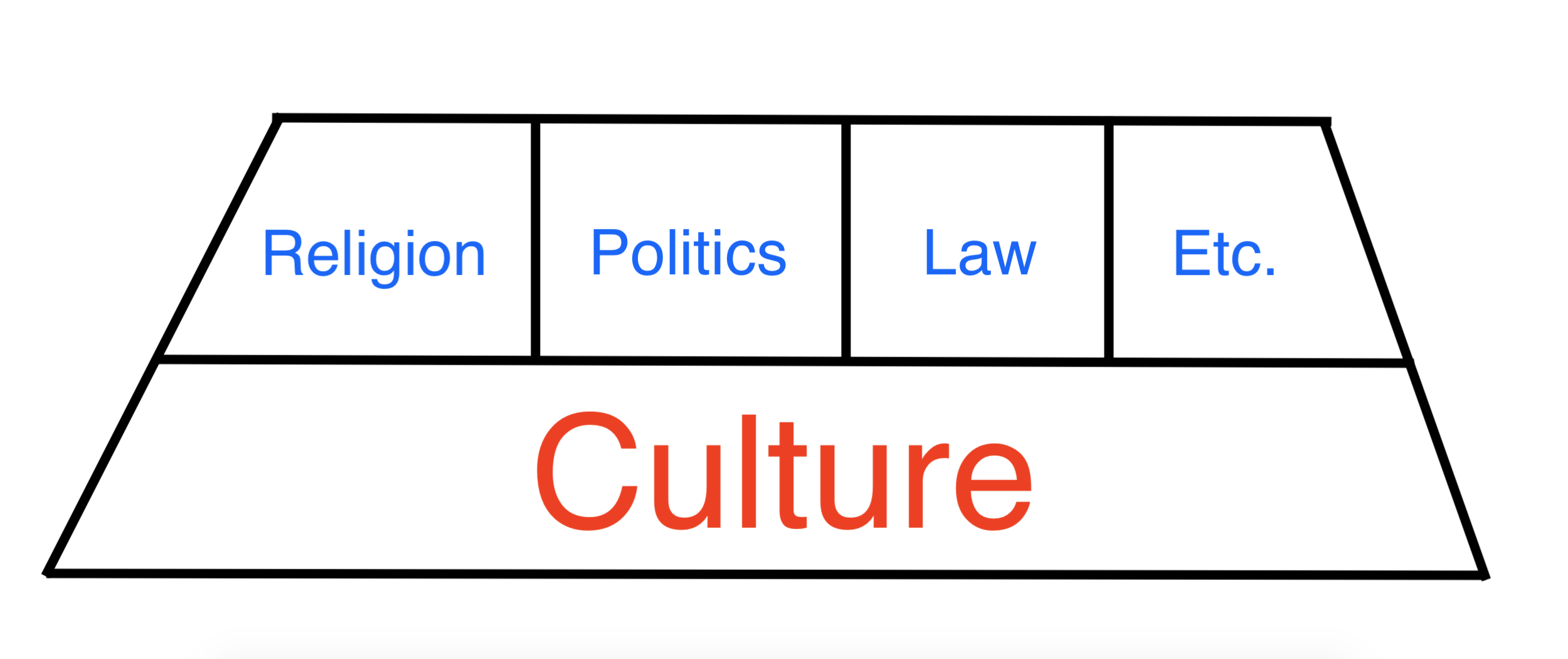
1. “Only with a good culture can we enjoy all of the good things that are available to us”
When I spend time with someone who grew up elsewhere and has lived for many years in the United States, I can, whether for better or worse for that particular person, feel the imprint of it on their soul.
Culture is like smoke: you can't be "in it" without "getting it on you".
2. Finding One’s People
My father once told me about watching two firefighters playing catch with a baseball in front of a fire station in Portland, Maine. It sounded nice.
I've noticed that people who have found happiness in life have usually "found their people" and become part of a trusted inner circle. Tenured professor, senior vice president, proud grandparent. Deep alignment with a culture.

3. Defending Culture
Culture is the most important thing in the world, so people will do most anything for it: risk imprisonment, risk their lives.
Communism and colonialism both usurp culture: ban religions, ban languages, erase histories.
4. The Forms of Heaven
The medieval French built beautiful cathedrals and chapels: physical reifications of abstract cultural motifs. Ends onto themselves.


The most beautiful chapel I've ever seen
The average Nordic prison, too, is a reflection of certain cultural ideals.
Each manifestation of a motif, like The Sainte-Chapelle Chapel, is luminous in the reflection of its ideals.
Joseph Campbell called this "the hieratic pantomime, making visible on earth the forms of heaven".¹⁷ It's really about which "forms of heaven" your culture truly prioritizes.
“We can only change the culture”
As Joscha Bach says, "What can we do about it? We can only change the culture."
How do we change the culture?
The 18th century Scottish philosopher David Hume had an oddly specific answer to this: be a public intellectual. Hume contrasted the academic philosopher, cloistered in an ivory tower, with the public intellectual, who spoke to the people.
"This is why Hume so deeply believed in the role and significance of public intellectuals. These were people who, unlike university professors that Hume grew to dislike immensely had to excite a passion-based attachment to ideas, wisdom, and insight. Only if they succeeded would they have the money to eat. It was for this reason that they had to write well, use colorful examples, and have recourse, wit, and charm. Hume's insight is that if you want to change people's beliefs, reasoning with them like a normal philosophy professor won't be the most effective strategy. He's pointing out that we have to try to adjust sentiments by sympathy, reassurance, good example, encouragement, and what he called art."¹⁸
Public intellectuals: from Joan of Arc to Carl Sagan.
Another Way to Change the Culture
"You can't fix stupid"
-Ron White¹⁹
Public intellectuals can change the culture, but cultural change is often gradual; glacial, even.
Moreover, change is often only in a subculture. Many people have had the experience of a passing association with a well-organized, moral, and even pleasant institution, such as a university or a good job, followed by a jarring return to the outside world.
What's the solution?
I suggest another interpretation of "change the culture": move yourself to another culture.
You can do both, as well. You can be a public intellectual and move to a culture that suits you. You can often best effect change from outside the storm.
Lastly, this bears repeating: you can't be "in it" without "getting it on you".
"He saw his ship approaching the harbour, and upon her prow the mariners, the men of his own land.
And his soul cried out to them, and he said:
Sons of my ancient mother, you riders of the tides,
How often have you sailed in my dreams."
-Kahlil Gibran²⁰
Sources:
¹: https://www.abc.net.au/news/2022-10-05/what-are-nordic-prisons-like-criminal-justice/101481590
²: https://www.youtube.com/watch?v=FMfA6i60WDA
³: https://www.thoughtco.com/history-of-steam-engines-4072565
⁴: https://lukemuehlhauser.com/there-was-only-one-industrial-revolution
⁵: https://en.wikipedia.org/wiki/Vermont_health_care_reform
⁶: https://apps.bea.gov/iTable/index.html?appid=70&stepnum=40&Major_Area=3&State=0&Area=XX&TableId=21&Statistic=3&Year=2014&YearBegin=-1&Year_End=-1&Unit_Of_Measure=levels&Rank=1&Drill=1&nRange=5
⁷: https://tax.vermont.gov/sites/tax/files/documents/2014IncBk-web_0.pdf (page 25
⁸: https://www.philanthropyroundtable.org/almanac/who-gives-most-to-charity
⁹: https://www.goodreads.com/work/quotes/18583136-preu-entum-und-sozialismus
¹⁰: https://en.wikipedia.org/wiki/Hofstede%27s_cultural_dimensions_theory
¹¹: https://en.m.wikipedia.org/wiki/File:Hofstede_4countries_6_dimensions.png
¹²: https://clearlycultural.com/geert-hofstede-cultural-dimensions/individualism/
¹³: https://en.wikipedia.org/wiki/File:TFS_fire_equipment.jpg By Joshua Sherurcij
¹⁴: https://commons.wikimedia.org/wiki/File:Sainte_Chapelle-_Upper_level_1.jpg?uselang=fr by Benh LIEU SONG
¹⁵: https://commons.wikimedia.org/wiki/File:Sainte_Chapelle_Interior_Stained_Glass.jpg By Oldmanisold
¹⁶: https://www.abc.net.au/news/2022-10-05/what-are-nordic-prisons-like-criminal-justice/101481590
¹⁷: https://www.jcf.org/product-page/the-hero-with-a-thousand-faces-ebook (page 358)
¹⁸: https://lmscontent.embanet.com/MVU/NURS600/Transcripts/MVU_NURS600_Hume.html
¹⁹: [https://www.goodreads.com/author/quotes/15169.Ron_White
²⁰: [https://www.gutenberg.org/files/58585/58585-h/58585-h.htm