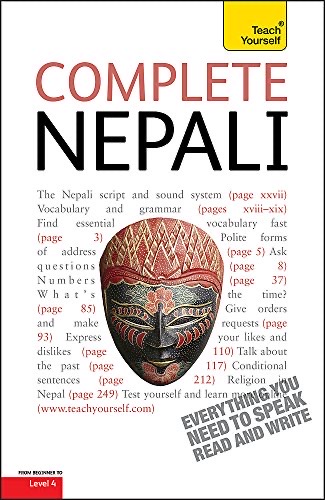
Complete Nepali: A Teach Yourself Guide
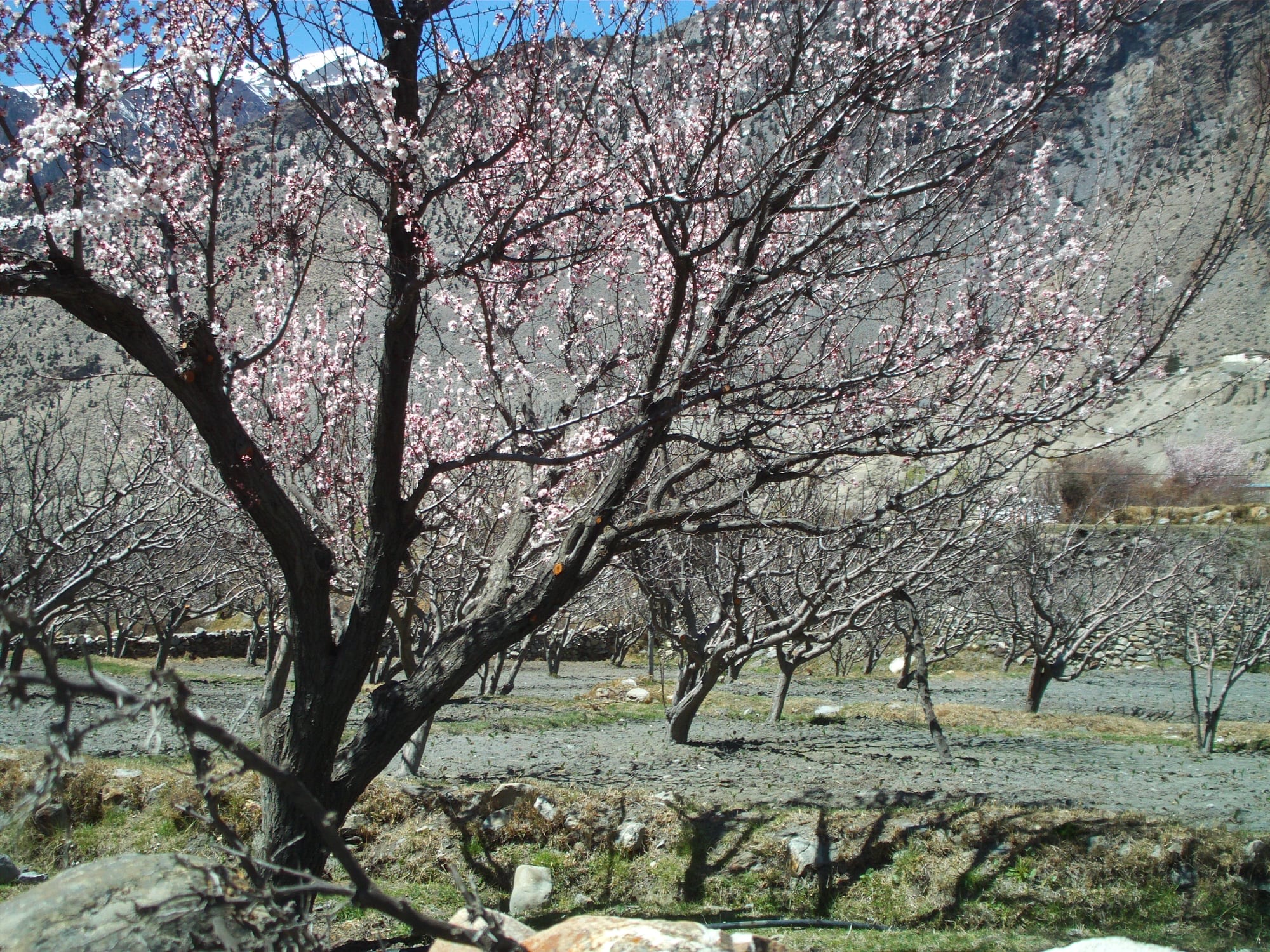
I took the photo in 2010.
I read Complete Nepali in around the summer of 2011. I listened to the audio on the accompanying CDs. The audio was great: realistic mock conversations on a range of topics. The voice actors are all native speakers. They also intentionally speak slowly. I found that speed adjustment particularly helpful with picking out individual words from a given sentence.
Computing meaning is real-time is a tough barrier with a language. Someone once told me they had a moment when their Italian host parent was speaking Italian, when the sentence parsed as discrete words, rather than a stream of sound. After that, she felt she had a "foothold".
I quite liked the structure of the book. It's pragmatically organized. Each section is "here's a grammatical structure that's practical in common speech". For example, "here's the grammatical structure for saying "x is for y" (को लागि). Or, "here's how to conjugate for the simple past tense".
Each such structure was taught with examples and commonly-used words. I think there was a list at the end of each chapter of the words introduced in that chapter. In that way, building a practical lexicon was as a matter of course, happening in context and by example.
Quite an illustrious group of authors: all three are university professors. Abhi Subedi is a renowned literary figure. He's a poet, playwright, and novelist. He's written dozens of books.
I studied abroad in Nepal in the spring of 2010. I mostly lived in the Kathmandu Valley, with some time spent in the Terai and in the Annapurna region.
I studied Nepali formally for a semester while studying abroad in Nepal, then studied it on my own afterward. The study abroad program had a particularly intense language component. For example, studying in Spain you might have language class 3 days a week, or something like that. We had language class 5 days a week.
Beyond the textbook and dictionary for the Nepali class used in the college course, I've used "A Foundation in Nepali Grammar" by Christopher Jay Manders, Nepali radio shows and music (Nepathya!), and "A Practical Dictionary of Modern Nepali" by Ruth Laila Schmidt. Schmidt's book is particularly excellent. It's available here: link.
I was greatly aided, especially after the study abroad program, by speaking with native speakers. They humored my struggles.
A remark from Dr. Hutt, one of the coauthors, has stuck with me. It was something like this: "Nepali is a language of great intimacy and wit".
Nepali is grammatically rich and sophisticated. It has case and declension - including ergativity, gender, agglutination, formality levels in both pronouns and conjugation, and strong use of postpositional markers. The postpositional markers in Nepali include को/ko ("belonging to"), लाई/laai (indirect object marker), मा/maa ("in, on, etc."), मुनि/muni ("under"), and सित/sita ("with").
I worked at a summer camp in 2011. I spent much of my downtime studying Nepali. A camper told me he heard Sanskrit would be the easiest language "for a computer to learn".
I'm not sure how exactly that would be quantified. However, it's true that Nepali is very logical and orderly. Nepali is highly related to Sanskrit. It is both a descendant of Sanskrit and quite well-preserved linguistically.
Nepali has exactly two irregular verbs in common use: हुनु/hunu ("to be") and जानु/janu ("to go"). Other than that, every single verb in every single tense is conjugated according to a standard pattern. I studied French in high school. There are whole books dedicated to listing out the irregularly conjugated verbs for French.
The regularity of conjugation was an aiding factor in learning the language. Others included its atonality (e.g. in contrast to Mandarin or Vietnamese, for example) and its genealogical closeness with English. Both are in the Indo-European language family - descendants of Proto-Indo-European.
Vis-à-vis its atonality and it's language family, near the end of the study abroad program, we met with students who had been in a program for the Tibetan language. They didn't speak Tibetan nearly as well, on average, as we spoke Nepali. That's probably because Tibetan is in the Sino-Tibetan language family - as is Mandarin Chinese. Like Mandarin, Tibetan has tones.
One of the languages besides Nepali that's spoken in Nepal is called Newari. It's interesting to contemplate that Nepali and English are more linguistically similar than are Nepali and Newari. Newari is also a Sino-Tibetan language, and is mostly spoken in the Kathmandu Valley.
Nepali has great prosody.
In 2012, I was speaking Nepali with a gentleman in New Hampshire. I used the phrase "अनि पछि निदो गर्नेछु/ani pacchi nido garchhu" (meaning: "and I'll decide later"). It occurred there's a prosody to a line like that: a-ni/pa-chhi, ni-do/gar-chhu. There's the vowel-terminated second syllable of all 4 words, the rhyming of "ni" and "chhi", and the slant rhyming of "chhi" and "chhu".
Studying Nepali has been a nice experience. Intimate, emotive, commanding, and sophisticated.