The Demon-Haunted World
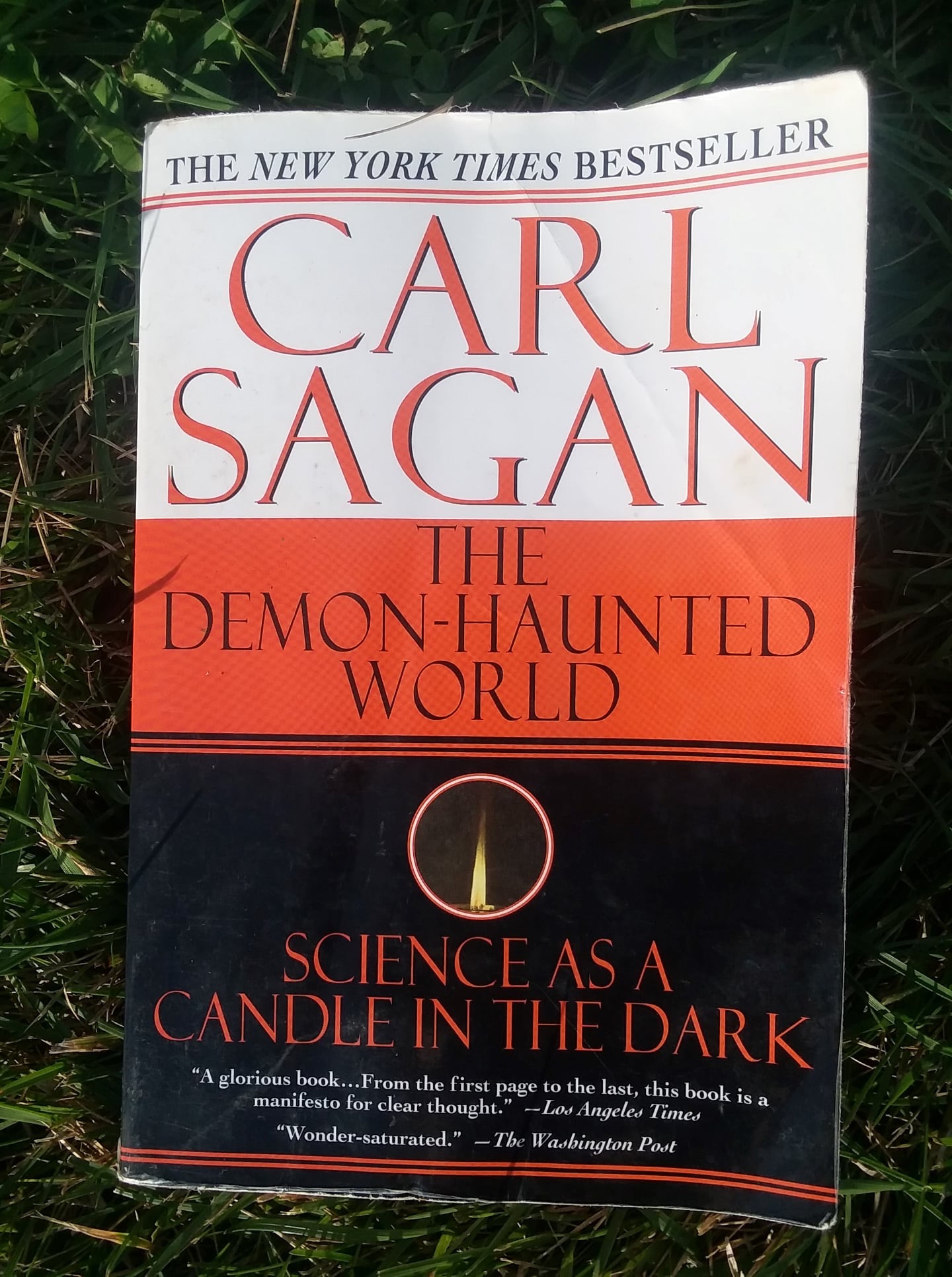
Photo taken summer/fall 2020
The 1939 New York World's Fair - that so transfixed me as a small visitor from darkest Brooklyn - was about "The World of Tomorrow." Merely by adopting such a motif, it promised that there would be a world of tomorrow, and the most casual glance affirmed that it would be better than the world of 1939. Although the nuance wholly passed me by, many people longed for such a reassurance on the eve of the most brutal and calamitous war in human history. I knew at least that I would be growing up in the future. The sleek and clean "tomorrow" portrayed by the Fair was appealing and hopeful. And something called science was plainly the means by which that future would be realized.
But if things had gone a little differently, the Fair could have given me enormously more. A fierce struggle had gone on behind the scenes. The vision that prevailed was that of the Fair's president and chief spokesman, Grover Whalen - former corporate executive, New York City police chief in a time of unprecedented police brutality, and public relations innovator. It was he who had envisioned the exhibit buildings as chiefly commercial, industrial, oriented to consumer products, and he who had convinced Stalin and Mussolini to build lavish national pavilions. (He later complained about how often he had been obliged to give the fascist salute.) The level of the exhibits, as one designer described it, was pitched to the mentality of a twelve-year-old."
However, as recounted by the historian Peter Kuznick of American University, a group of prominent scientists - including Harold Urey and Albert Einstein - advocated presenting science for its own sake, not just as the route to gadgets for sale; concentrating on the way of thinking and not just the products of science. They were convinced that broad popular understanding of science was the antidote to superstition and bigotry; that, as science popularizer Watson Davis put it, "the scientific way is the democratic way." One scientist even suggested that widespread public appreciation of the methods of science might work "a final conquest of stupidity" - a worthy, but probably unrealizable, goal.
As events transpired, almost no real science was tacked on to the Fair's exhibits, despite the scientists' protests and their appeals to high principles. And yet, some of the little that was added trickled down to me and helped to transform my childhood. The corporate and consumer focused remained central, though, and essentially nothing appeared about science as a way of thinking, much less as a bulwark of a free society.
-pages 403-404¹
Quite an incredible book. It was Sagan's final book. It's an unrestrained exposition of the core elements of Sagan's worldview; most especially science, pseudoscience, rationality, and wonder.
Sagan was diagnosed with bone marrow cancer (myelodysplasia) two years prior to his death from that disease, in 1996. The book was first published in 1995². He worked on the book, at least in part, while knowing he had cancer.
Sagan displayed a profound inquisitiveness from an early age.
Soon after entering elementary school, Sagan began to express his strong inquisitiveness about nature. He recalled taking his first trips to the public library alone, at age five, when his mother got him a library card. He wanted to learn what stars were, since none of his friends or their parents could give him a clear answer: "I went to the librarian and asked for a book about stars [...] and the answer was stunning. It was that the Sun was a star, but really close. The stars were suns, but so far away they were just little points of light. The scale of the universe suddenly opened up to me. It was a kind of religious experience. There was a magnificence to it, a grandeur, a scale which has never left me. Never ever left me."
I particularly liked Chapter 11, The City of Grief and Chapter 12, The Fine Art of Baloney Detection.
The City of Grief speaks to Sagan's experience interacting with the public. He put out an open request, via Parade Magazine, for responses from the public to his ideas on skepticism and scientific inquiry. What surprised Sagan the most was how many of the responses were indicative of a person in significant emotional, psychological, and just overall "life" distress.
Moving in the circles of high academia had perhaps sheltered him.
And thus the title of the chapter, which comes from a poem by the famous German poet Rainer Maria Rilke:
. . . how alien, alas, are the streets of the city of grief.as cited on page 179 of the book¹
Rainer Maria Rilke,
'The Tenth Elegy' (1923)
Chapter 12, The Fine Art of Baloney Detection, speaks to Sagan's beliefs around rigorous thinking and the naturally attendant dispellation of superstitions, hoaxes, and pseudoscience.
One of the sections from The Fine Art of Baloney Detection helped inspire an essay I wrote: Solved and Unsolved.
This is an excerpt from that section of the book:
A very different prospect for something like eternal life was once proposed by the versatile British scientist J.B.S. Haldane, who was, among many other things, one of the founders of population genetics. Haldane imagined a far future when the stars have darkened and space is mainly filled with a cold, thin gas. Nevertheless, if we wait long enough statistical fluctuations in the density of this gas will occur. Over immense periods of time the fluctuations will be sufficient to reconstitute a Universe something like our own. If the Universe is infinitely old, there will be an infinite number of such reconstitutions, Haldane pointed out.
So in an infinitely old universe with an infinite number of appearances of galaxies, stars, planets and life, an identical Earth must reappear on which you and all your loved ones will be reunited. I'll be able to see my parents again and introduce them to the grandchildren they never knew. And all this will happen not once, but an infinite number of times.
But in this reflection I have underestimated what infinity means. In Haldane's picture, there will be universes, indeed an infinite number of them, in which our brains will have full recollection of many previous rounds. Satisfaction is at hand — tempered, though, by the thought of all those other universes which will also come into existence (again, not once but an infinite number of times) with tragedies and horrors vastly outstripping anything I've experienced this turn.
The Consolation of Haldane depends, though, on what kind of universe we live in, and maybe on such arcana as whether there's enough matter eventually to reverse the expansion of the universe, and the character of vacuum fluctuations. Those with a deep longing for life after death might, it seems, devote themselves to cosmology, quantum gravity, elementary particle physics, and, especially, transfinite arithmetic.
-pages 192-193¹
Something that gave me distinct respect for Sagan is that he was twice arrested for trespassing, for attempting to climb a fence during a protest against nuclear weapons testing in Nevada.
He was in his 50s, a full professor at Cornell University, presumably quite wealthy, and world-famous. He could have written an editorial in a major publication, but instead he physically went out and put his freedom at risk.
Getting arrested for a cause is perhaps emblematic of Sagan more generally. He was an Ivy League professor. He was associated at various times with UChicago, Harvard, and Cornell He did cutting-edge astrophysics research, published over 600 scientific publications and more than 20 books, and even wrote a Pulitzer Prize-winning book. He was also a deeply successful mainstream popular culture figure. He wrote the novel for the highly successful Hugo Award-winning film Contact, and created and hosted the wildly popular TV show Cosmos, which won two Emmy awards and a Peabody Award.
And so he spanned what's usually a chasmic divide between high intelligentsia and mainstream popular culture. Similarly, he spanned the Ivy League and personally getting arrested—twice—for his beliefs.
Perhaps in part because Sagan wrote it while fighting the cancer that ultimately took his life, this book just feels different. It's more visceral, deep, eloquent, and intense than typical scientific communication. The most deeply felt beliefs of a dying genius.
Sources:
¹: ia801202.us.archive.org/6/items/DemonHauntedWorld_carlSagan/Sagan_-The_Demon-Haunted_World__Science_as_a_candle_in_the_dark.pdf
²: en.wikipedia.org/wiki/Carl_Sagan
³: en.wikipedia.org/wiki/The_Demon-Haunted_World