A Mind in Love
The mind, disposed to love at its creation,
is readily moved toward anything that pleases
as soon as by that pleasure it is roused to act.
'From real forms your perception draws
an image it unfolds within you
so that the mind considers it,
and if the mind, so turned, inclines to it,
that inclination is a natural love,
which beauty binds in you at once.
Then, as fire, born to rise,
moves upward in its essence,
to where its matter lives the longest,
just so the mind, thus seized, achieves desire,
a movement of the spirit never resting
as long as it enjoys the thing it loves.
-Canto 18 of Purgatorio, from The Divine Comedy by Dante42
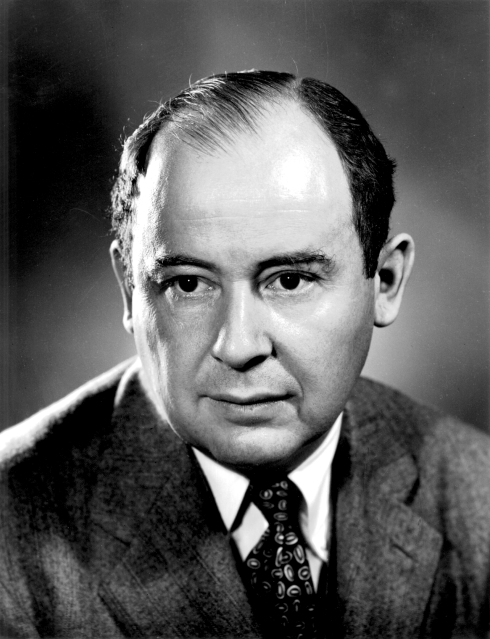
Years ago, I read an article in Rolling Stone magazine about an intellectually gifted young man named Santiago Gonzales. When I think of Dr. John von Neumann, I'm reminded of a quote from that article:
Santiago also had a quality shared by many exceptionally gifted kids: a compulsive drive to learn. One prominent researcher used Dante's phrase "a mind in love" [I believe based on the quoted passage above] to describe the intensity of the feeling; it was a "burning desire" whose gratification would yield an almost sensual ecstasy. Another researcher wrote that, for the gifted, love of learning is "not a matter of degree, but a different quality of experiencing: vivid, absorbing, penetrating, encompassing, complex, commanding — a way of being quiveringly alive."51
Early Life
Von Neumann was born in Budapest, Kingdom of Hungary (then part of Austria-Hungary), on December 28, 1903, to a wealthy, non-observant Jewish family. His birth name was Neumann János Lajos. In Hungarian, the family name comes first, and his given names are equivalent to John Louis in English.1
[von Neumann was a] child prodigy who at six years old could divide two eight-digit numbers in his head and converse in Ancient Greek.
He grew up studying at least seven languages, and could speak that many as an adult. By the time he was 8 years old, von Neumann was versed in both differential and integral calculus [...].26
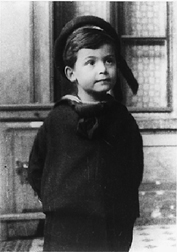
At 15 years old, von Neumann so impressed the Hungarian mathematician Gábor Szegő with his mathematical abilities that Szegő cried tears of joy.7
By the age of 19, von Neumann had published two major mathematical papers, the second of which gave the modern definition of ordinal numbers, which superseded Georg Cantor's definition.1
Georg Cantor is an immensely famous mathematician who co-founded the field of Set Theory.43 von Neumann's definition of ordinal numbers is the standard definition still used to this day.27
For his university schooling, von Neumann simultaneously undertook a degree in chemical engineering from ETH Zurich (Albert Einstein's alma mater) and a PhD in mathematics from Pázmány Péter University in Budapest. His dad, a pragmatically minded banker, recommended the chemical engineering degree. It wasn't a typical parental pressure situation though: von Neumann and his father brainstormed options and together decided on chemical engineering.1
It seems he dodged "do what makes you money or do what you're passionate about" by doing both. He completed both degrees in 1926. He received his PhD in mathematics summa cum laude, with minors in experimental physics and chemistry. He then completed his Habilitation, which is like a European postdoc. His Habilitation qualified him to be a university professor.1
After his schooling, he became a "Privatdozent" at the University of Berlin. A Privatdozent is like a lecturer/professor. He was "the youngest person ever elected Privatdozent in the university's history in any subject".1 "He [then] began writing nearly one major mathematics paper per month."1
von Neumann worked for a few years as a lecturer for universities in Germany, then took a role as a visiting lecturer at Princeton University in the United States.1 Shortly afterward, he accepted a position as a tenured professor at the Institute for Advanced Study, which is in the same town as Princeton University.14 Incidentally, von Neumann had the same job as Albert Einstein. Albert Einstein was a tenured professor at the IAS for the last 12 years of his (Einstein's) life.59
In fact, Einstein and von Neumann were two of the first four people hired by the IAS.59 The four were John von Neumann, Kurt Gödel, Hermann Weyl, and Albert Einstein.59 von Neumann remained a professor at the Institute for Advanced Study for the rest of his life.44
In 2021, I bought a book of some of von Neumann's correspondences: John von Neumann: Selected Letters, edited by Miklós Rédei.
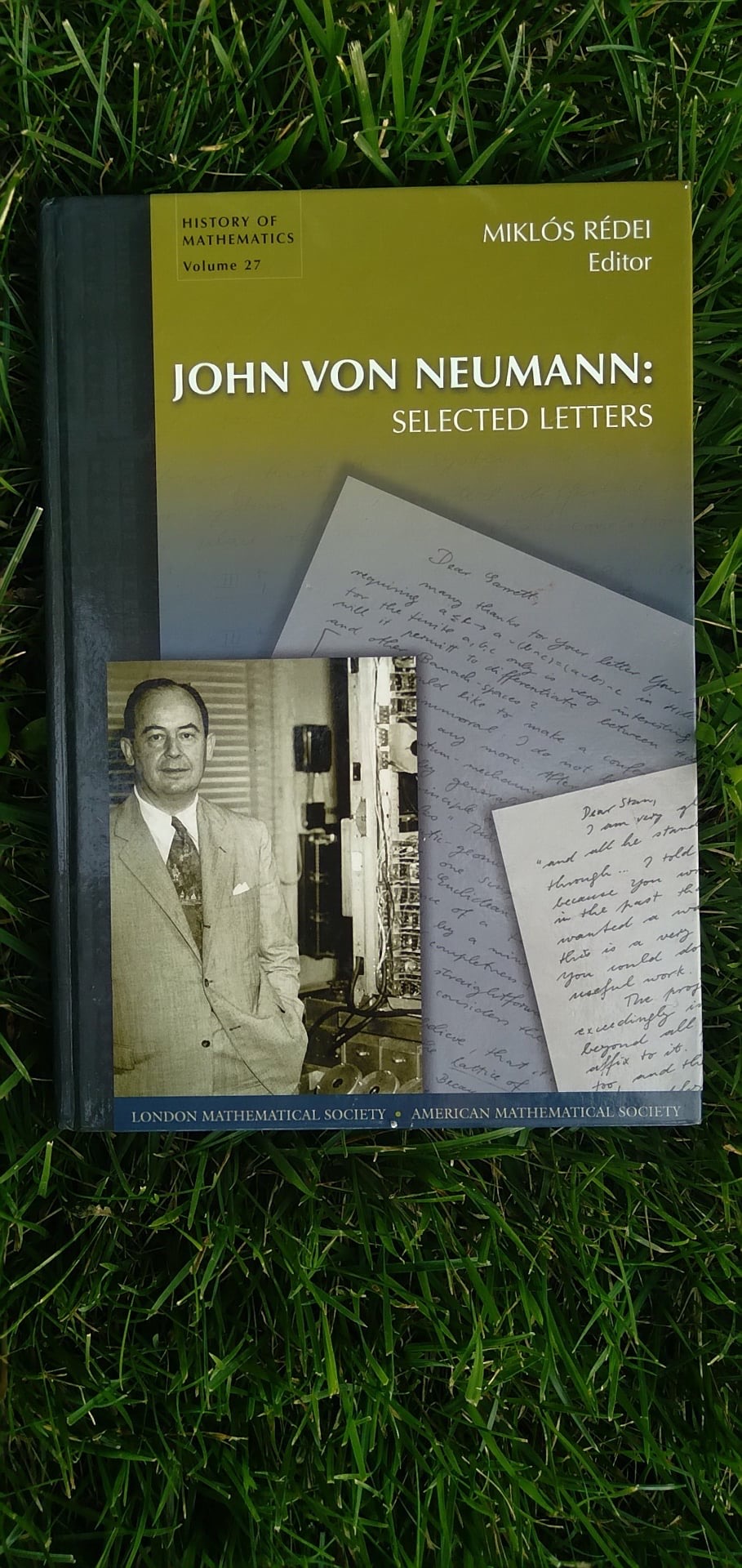
I skipped around in the book and didn't read all of it, but it was great. It was interesting to see how polite and socially dexterous von Neumann was. It was also interesting how he adjusted his communication style when speaking with people in administrative roles versus when speaking with mathematicians and scientists. I recall that he was more "to the point" when speaking with mathematicians and scientists, dispensing a bit with the pleasantries. I think of it as fewer pleasantries in a genial way, rather like how one talks with an old friend.
The Institute for Advanced Study (IAS) is an interesting place.
[The] guiding principle in founding the institute was the pursuit of knowledge for its own sake. The faculty have no classes to teach. There are no degree programs or experimental facilities at the institute. Research is never contracted or directed. It is left to each individual researcher to pursue their own goals.14
Interestingly, the IAS is completely separate from Princeton University. While there are collaborations and programs that informally link the two, and they're in the same town (the town is named Princeton), it's a completely separate institution. The IAS was created kind of "out of nowhere" with funding from a brother and sister—Louis Bamberger and Caroline Bamberger Fuld—who owned a department store in Newark, New Jersey. The store was called "Bamberger's." It sold clothes and such.14
I used to live and work in Central New Jersey, not far from Princeton. I loved visiting Princeton: thinking about the history, seeing the historic places, and just the town overall.
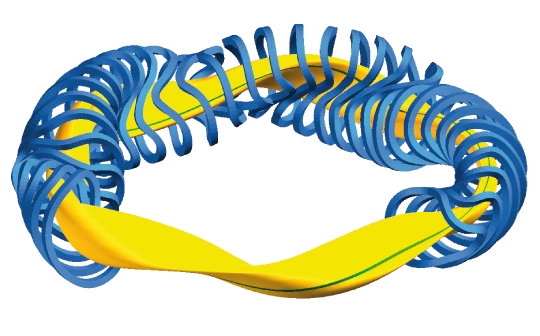
I remember once, when driving in Princeton, seeing a sign for a road named Stellarator Road. "Stellarator" is the name of a kind of nuclear fusion reactor architecture in which plasma is magnetically confined.29
The name "stellarator" refers to stars because fusion mostly occurs in stars such as the Sun. ...The stellarator was invented by American scientist Lyman Spitzer in 1951. Much of its early development was carried out by Spitzer's team at what became the Princeton Plasma Physics Laboratory (PPPL). Spitzer's Model A began operation in 1953 and demonstrated plasma confinement.29
I'd (vaguely) heard of the Stellarator (I think I thought it was a particle accelerator) and so when I saw the road name I was like "oh that's super cool". Physics doesn't have a lot of visibility in the everyday world, so it was nice to see.
The address of the Princeton Plasma Physics Laboratory is 100 Stellarator Road, Princeton, NJ.24
Princeton is a beautiful town with a nice university campus. Many buildings on campus are in gray stone in a "Collegiate Gothic" architectural style.30
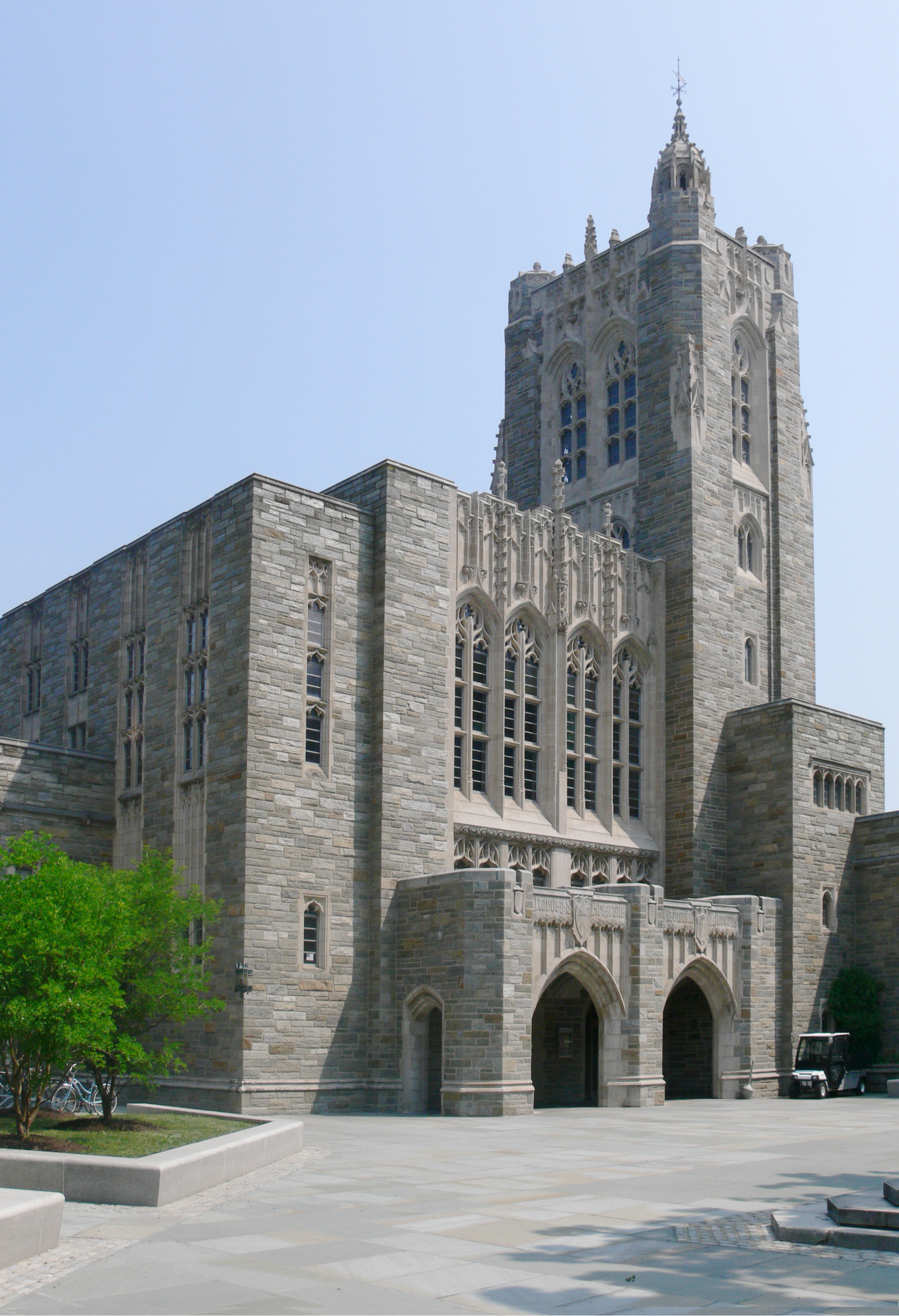
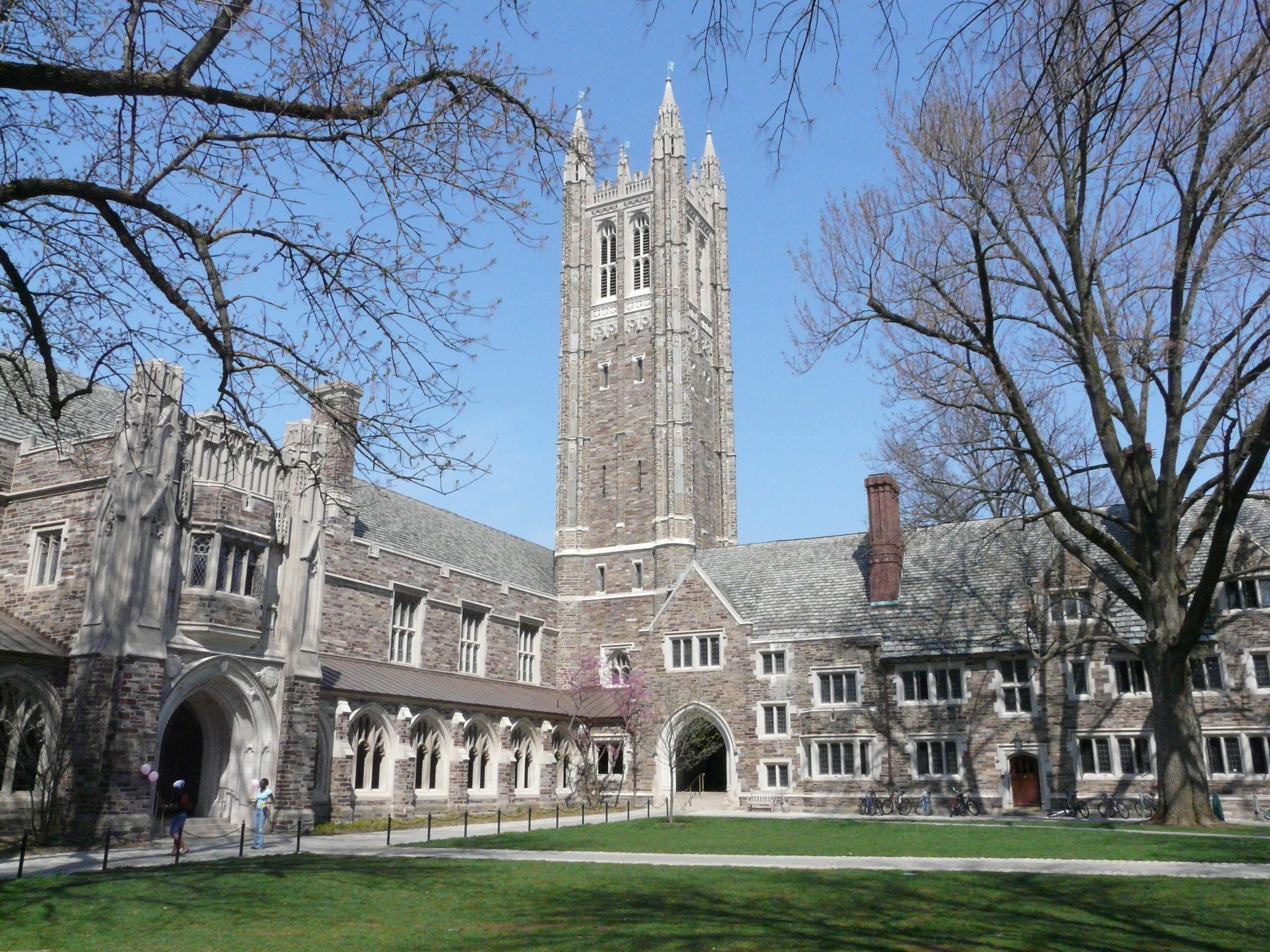
One time when I lived in central New Jersey, my dad traveled from out of state to meet me. We met in Princeton. I asked for us to rendezvous at John von Neumann's house. I said it a bit tongue-in-cheek, as though we were meeting at an old friend's house. And we did: we met at John von Neumann's house.
Here it is—John von Neumann's former home in Princeton, at 26 Westcott Road:45



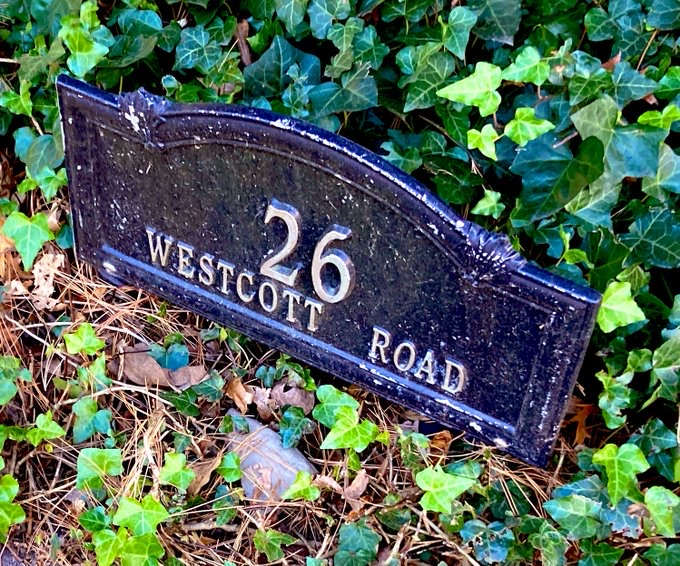
After meeting at the house, we walked to Kurt Gödel's house (Kurt Gödel was a very famous mathematician), which is right nearby. Albert Einstein's house is nearby too.
This is a photo of Einstein and von Neumann: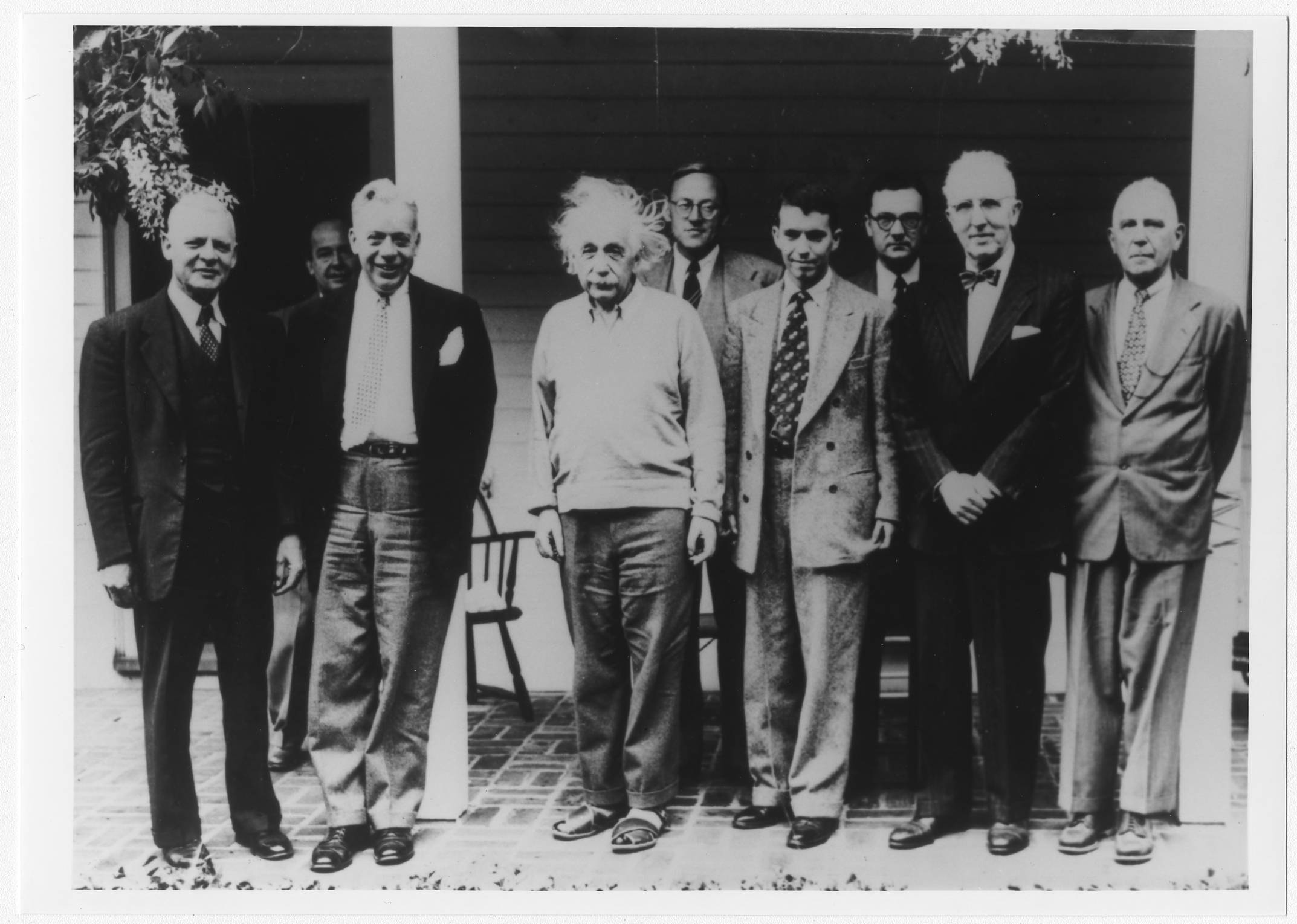
On the same trip, my dad and I visited the Institute for Advanced Study. We walked on the trails in the Institute Woods, which are open to the public.
There's a walking tour of Princeton called "From Genius to Genius."21 The tour stops at the homes of famous people who used to live in Princeton, including Einstein, von Neumann, Gödel, and Thomas Mann.21 You can check it out here: link.
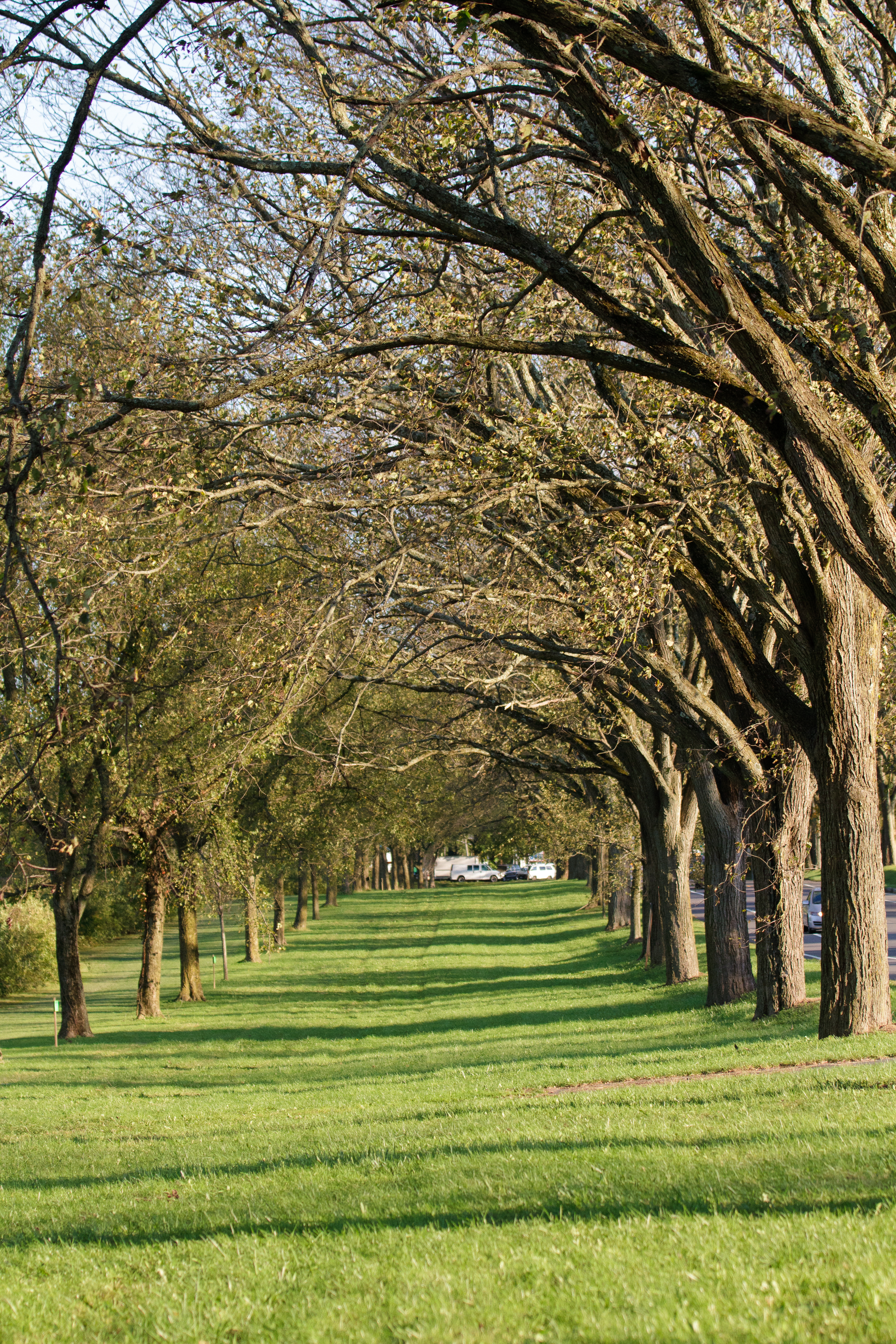
Another time, years later, I visited a friend who lived near the IAS. Just as when my father visited, my friend and I went to the Institute Woods. This is a photo I took that day of some IAS buildings, taken from the walking trails in the Institute Woods:
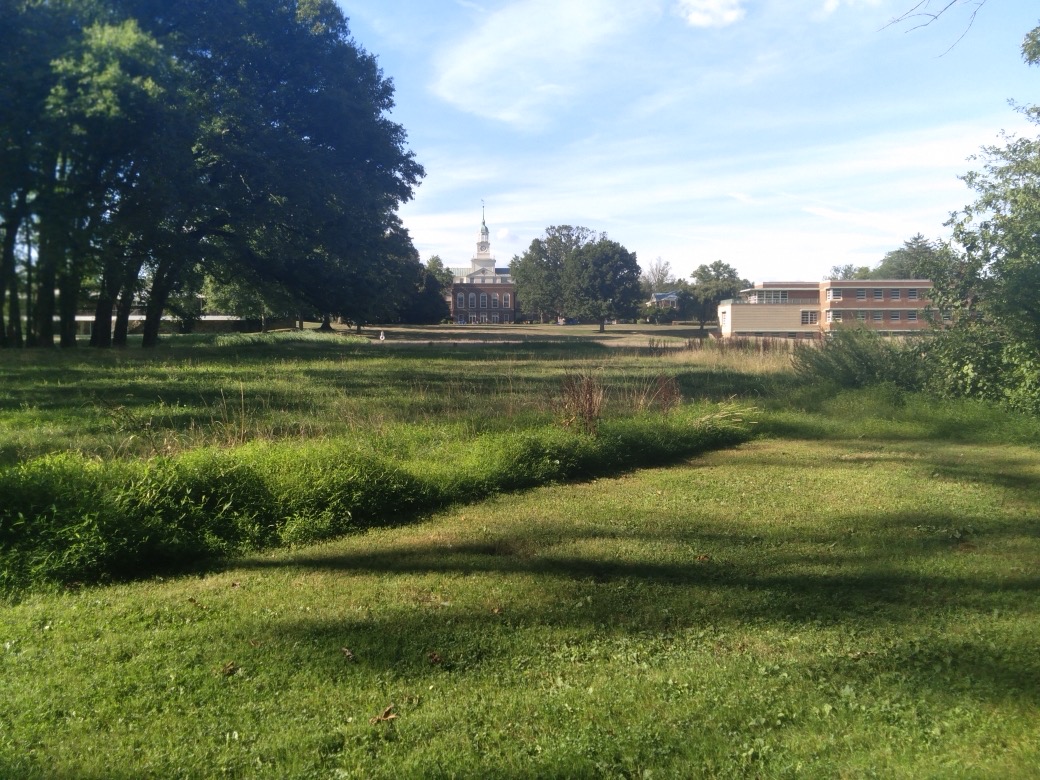
More photos I took in the Institute Woods that day:
One time in college, I went to a panel at which alums talked about their life experiences. One of the alums was (or had recently been, I don't remember) a fellow at the IAS, doing theoretical physics research.
As mentioned above, IAS fellows don't have any specific required professional duties whatsoever. The alum said something like this: although you could technically do nothing all day, the environment itself of the IAS makes you want to do great work. I still think about that sometimes. It sounds awesome.
von Neumann's intellectual abilities were prodigious.
He may have had the best memory of anyone who's ever lived about whom there's a definitive historical record.
In the article I mentioned above about the intellectually gifted student named Santiago Gonzales, it's mentioned that Santiago is "profoundly gifted", a formal designation62 (I hesitate to call it a "diagnosis" because it doesn't seem like a disease or disorder).
It seems to me that von Neumann was profoundly gifted too.
This is a list of "ten common characteristics of profoundly gifted students"57:
1. Ability to see things from a variety of perspectives
2. Advanced language skills
3. Critical of self and others
4. Early and rapid learning
5. Intellectual curiosity
6. Overexcitability
7. Perfectionism
8. Persistence
9. Quirky and/or keen sense of humor
10. Strong empathy and sense of justice57
Von Neumann was also noted for his eidetic memory, particularly of the symbolic kind. Herman Goldstine writes:
One of his remarkable abilities was his power of absolute recall. As far as I could tell, von Neumann was able on once reading a book or article to quote it back verbatim; moreover, he could do it years later without hesitation. He could also translate it at no diminution in speed from its original language into English. On one occasion I tested his ability by asking him to tell me how A Tale of Two Cities started. Whereupon, without any pause, he immediately began to recite the first chapter and continued until asked to stop after about ten or fifteen minutes. Von Neumann was reportedly able to memorize the pages of telephone directories. He entertained friends by asking them to randomly call out page numbers; he then recited the names, addresses and numbers therein.1
He knew Hungarian, French, German and English fluently, and maintained a conversational level of Italian, Yiddish, Latin and Ancient Greek. His Spanish was less perfect.1
A Princeton Professor of Byzantine History once said that he would only attend one of von Neumann's famous parties if von Neumann promised not to bring up the subject of Byzantine history, because many thought the professor to be the world's foremost expert on the subject, and he did not want anyone to know that that title might actually belong to von Neumann.47
You know, Herb, Johnny can do calculations in his head ten times as fast as I can. And I can do them ten times as fast as you can, so you can see how impressive Johnny is.
-Enrico Fermi (Nobel Prize in Physics, 1938)17
One had the impression of a perfect instrument whose gears were machined to mesh accurately to a thousandth of an inch.
-Eugene Wigner (Nobel Prize in Physics, 1963) speaking about von Neumann's brain17
I have known a great many intelligent people in my life. I knew Max Planck, Max von Laue, and [Werner] Heisenberg. Paul Dirac was my brother-in-law; Leo Szilard and Edward Teller have been among my closest friends; and Albert Einstein was a good friend, too. And I have known many of the brightest younger scientists. But none of them had a mind as quick and acute as Jancsi von Neumann. I have often remarked this in the presence of those men, and no one ever disputed me.
-Eugene Wigner (Nobel Prize in Physics, 1963)20
von Neumann was extremely professionally productive. He made seminal scientific discoveries across multiple disciplines. He did deeply influential work in geopolitics and with the US military in particular, including playing a key role in winning World War II. That's a rare combination: elite scientific impact and elite political impact.
Major themes of his life include mathematics, politics, the military, physics, and computing. In each of those, he was world-changingly successful. Some examples:
Mathematics:
von Neumann was fundamentally a mathematician by training and trade. He did deep work in multiple fields of mathematics. Perhaps most famously, he founded game theory22.
By 1928, when he wrote "The Theory of Parlor Games," which contained a proof of the famous Minimax Theorem, von Neumann had become a wunderkind. Described as the seminal paper on game theory, "The Theory of Parlor Games" concerned two-person zero-sum games (where the gain of one participant is the loss of the other).22
von Neumann did work on set theory that established a solid foundation of mathematics itself:
At the beginning of the 20th century, efforts to base mathematics on naive set theory suffered a setback due to Russell's paradox (on the set of all sets that do not belong to themselves). The problem of an adequate axiomatization of set theory was resolved implicitly about twenty years later by Ernst Zermelo and Abraham Fraenkel. Zermelo–Fraenkel set theory provided a series of principles that allowed for the construction of the sets used in the everyday practice of mathematics, but did not explicitly exclude the possibility of the existence of a set that belongs to itself. In his 1925 doctoral thesis, von Neumann demonstrated two techniques to exclude such sets—the axiom of foundation and the notion of class.1
von Neumann was the first person to recognize the significance of Gödel's first incompleteness theorem, and independently disocovered Gödel's second incompleteness theorem. Gödel incompleteness theorems are earth-shatteringly famous and important results in the foundations of mathematics itself.
Gödel announced his first incompleteness theorem at a roundtable discussion session on the third day of the conference. The announcement drew little attention apart from that of von Neumann, who pulled Gödel aside for a conversation. Later that year, working independently with knowledge of the first incompleteness theorem, von Neumann obtained a proof of the second incompleteness theorem, which he announced to Gödel in a letter dated November 20, 1930.[30] Gödel had independently obtained the second incompleteness theorem and included it in his submitted manuscript, which was received by Monatshefte für Mathematik on November 17, 1930.63
Lattice theory:
Between 1935 and 1937, von Neumann worked on lattice theory, the theory of partially ordered sets in which every two elements have a greatest lower bound and a least upper bound. As Garrett Birkhoff wrote, "John von Neumann's brilliant mind blazed over lattice theory like a meteor".1
Ergodic theory:
Of the 1932 papers on ergodic theory, Paul Halmos wrote that even "if von Neumann had never done anything else, they would have been sufficient to guarantee him mathematical immortality".1
Operator theory:
His work on operator theory led to his most profound invention in pure mathematics, the study of von Neumann algebras and in general of operator algebras.1
Politics and the Military:
He did critical work on the Manhattan Project. Von Neumann became a leading authority on the mathematics of shaped charges, explosive charges shaped to focus the effect of the energy of an explosive.1 He was instrumental in the design of the second atomic bomb and therefore in winning World War II.13
Von Neumann made his principal contribution to the atomic bomb in the concept and design of the explosive lenses that were needed to compress the plutonium core of the Fat Man weapon that was later dropped on Nagasaki. While von Neumann did not originate the "implosion" concept, he was one of its most persistent proponents, encouraging its continued development against the instincts of many of his colleagues, who felt such a design to be unworkable. He also eventually came up with the idea of using more powerful shaped charges and less fissionable material to greatly increase the speed of "assembly."
When it turned out that there would not be enough uranium-235 to make more than one bomb and also that plutonium-239 could not be used in the Thin man bomb, the implosive lens project was greatly expanded and von Neumann's idea was implemented. Implosion was the only method that could be used with the plutonium-239 that was available from the Hanford Site. He established the design of the explosive lenses required, but there remained concerns about "edge effects" and imperfections in the explosives. His calculations showed that implosion would work if it did not depart by more than 5% from spherical symmetry. After a series of failed attempts with models, this was achieved by George Kistiakowsky, and the construction of the Trinity bomb was completed in July 1945.1
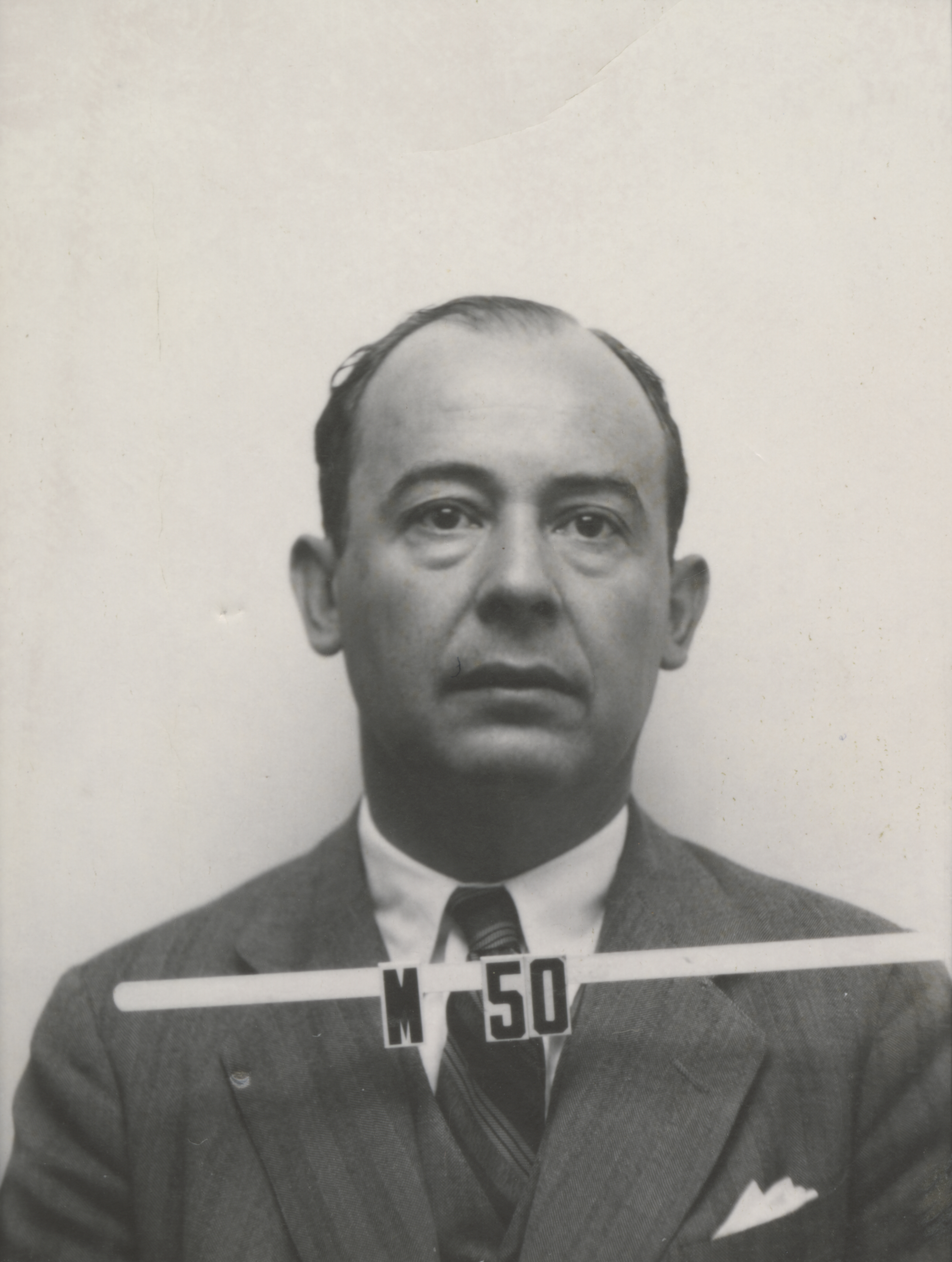
For his wartime services, von Neumann was awarded the Navy Distinguished Civilian Service Award in July 1946, and the Medal for Merit in October 1946.1
Physics:
Here I'll give a fuller picture of von Neumann's work in physics, rather than just a sampling. That's in part because physics has a greater presence in the public consciousness than mathematics does (Einstein is universally famous, Grothendieck is not), and in part for a contrastive sense of scale. In terms of scale, see the note at the end of this section stating that the scale of his work in physics was much smaller than the scale of his work in mathematics. And the scale and importance of his work in physics were immense.
Von Neumann was the first to establish a rigorous mathematical framework for quantum mechanics, known as the Dirac–von Neumann axioms, in his influential 1932 work Mathematical Foundations of Quantum Mechanics.1
Mathematical Foundations of Quantum Mechanics was a full book, at 328 pages in one of its editions, and he's the sole author35.
Von Neumann's abstract treatment permitted him to confront the foundational issue of determinism versus non-determinism, and in the book he presented a proof that the statistical results of quantum mechanics could not possibly be averages of an underlying set of determined "hidden variables", as in classical statistical mechanics.1
Von Neumann's proof inaugurated a line of research that ultimately led, through Bell's theorem and the experiments of Alain Aspect in 1982, to the demonstration that quantum physics either requires a notion of reality substantially different from that of classical physics, or must include nonlocality in apparent violation of special relativity.1
Quantum information theory is largely concerned with the interpretation and uses of von Neumann entropy, a cornerstone in the former's development; the Shannon entropy applies to classical information theory.1
The von Neumann measurement scheme, the ancestor of quantum decoherence theory, represents measurements projectively by taking into account the measuring apparatus which is also treated as a quantum object. The 'projective measurement' scheme introduced by von Neumann led to the development of quantum decoherence theories.1
Von Neumann first proposed a quantum logic in his 1932 treatise Mathematical Foundations of Quantum Mechanics, where he noted that projections on a Hilbert space can be viewed as propositions about physical observables. The field of quantum logic was subsequently inaugurated in a 1936 paper by von Neumann and Garrett Birkhoff, the first to introduce quantum logics, wherein von Neumann and Birkhoff first proved that quantum mechanics requires a propositional calculus substantially different from all classical logics and rigorously isolated a new algebraic structure for quantum logics.1
Quantum logic remains in use among logicians and interests are expanding through the recent development of quantum computing, which has engendered a proliferation of new logics for formal analysis of quantum protocols and algorithms [...]. The logic may also find application in (computational) linguistics.38
During WWII, von Neumann made fundamental contributions in the field of fluid dynamics, including the classic flow solution to blast waves now called Taylor–von Neumann–Sedov blast wave after three scientists who devised it independently, and the co-discovery (independently by Yakov Borisovich Zel'dovich and Werner Döring) of the ZND detonation model of explosives.1
Note the "While not as prolific in physics as he was in mathematics"1 part here (!):
While not as prolific in physics as he was in mathematics, he nevertheless made several other notable contributions. His pioneering papers with Subrahmanyan Chandrasekhar on the statistics of a fluctuating gravitational field generated by randomly distributed stars were considered a tour de force. In this paper they developed a theory of two-body relaxation and used the Holtsmark distribution to model the dynamics of stellar systems. He wrote several other unpublished manuscripts on topics in stellar structure, some of which were included in Chandrasekhar's other works. In earlier work led by Oswald Veblen von Neumann helped develop basic ideas involving spinors that would lead to Roger Penrose's [a 2020 Nobel Prize winner in physics!] twistor theory. Much of this was done in seminars conducted at the IAS during the 1930s. From this work he wrote a paper with A. H. Taub and Veblen extending the Dirac equation to projective relativity, with a key focus on maintaining invariance with regards to coordinate, spin, and gauge transformations, as a part of early research into potential theories of quantum gravity in the 1930s.1
Meteorology:
That's right: meteorology!
By 1950 von Neumann and Charney wrote the world's first climate modelling software, and used it to perform the world's first numerical weather forecasts on the ENIAC computer that von Neumann had arranged to be used; von Neumann and his team published the results as Numerical Integration of the Barotropic Vorticity Equation. Together they played a leading role in efforts to integrate sea-air exchanges of energy and moisture into the study of climate.1
He co-founded computerized weather forecasting!
Computing:
von Neumann was on the ground floor of the development of the modern computer. He was a contemporary of Alan Turing, with whom he interacted professionally.
Shortly after, in 1935, von Neumann finds his way into the first line of the first sentence in Turing's first published paper: "In his [1934] paper 'Almost periodic functions in a group,' J. v. Neumann has used independently the ideas of left and right periodicity. I shall now show that these are equivalent." Such a demonstration of Turing's power of proof must have caught von Neumann's attention, for in 1937 he wrote a letter in support of a Princeton fellowship for Turing, and in 1938 offered Turing a position as his assistant which, although it paid $1,500 a year, Turing declined as the shadows of war lengthened in Europe.10
(The admiration was mutual. In a letter written home from Princeton, von Neumann's is the first name on a list of Princeton luminaries that included "Weyl, Courant, Hardy, Einstein, Lefschetz, as well as hosts of smaller fry.")10
He was working heavily on computation in the 1940s, including work on the design and construction of computers such as ENIAC, EDVAC, and the IAS machine. The first of those, the ENIAC, is pictured below. J. Robert Oppenheimer stands next to von Neumann.
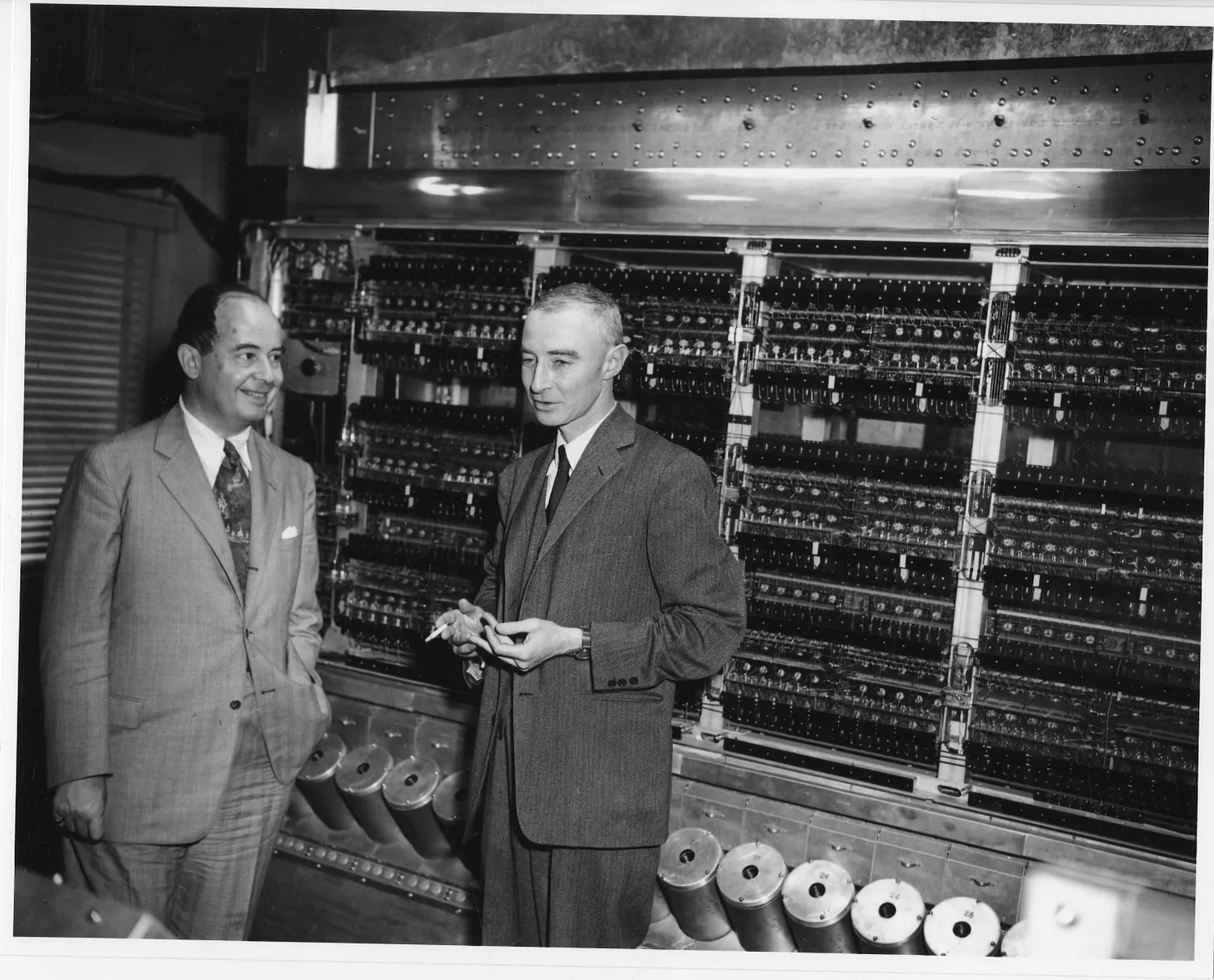 53
ENIAC (Electronic Numerical Integrator and Computer) was the first programmable, electronic, general-purpose digital computer, completed in 1945. Other computers had some of these features, but ENIAC was the first to have them all. ENIAC was Turing-complete and able to solve "a large class of numerical problems" through reprogramming.12
In other words, the argument can be made that ENIAC was the first real computer. von Neumann was one of the chief developers of the ENIAC12:
During the Second World War, Von Neumann was a consultant to the Manhattan Project at Los Alamos, and was heavily involved in the intensive mathematical calculations needed to design the atomic bomb. In 1944 this need for calculating power led him to the ENIAC, a clumsy electronic behemoth built by the University of Pennsylvania for the US Army's Ballistics Research Laboratory. Von Neumann collaborated with the designers of the ENIAC to produce a more effective design, which we now know as the stored-program computer – the blueprint for the post-war computer revolution.
He was woking on the ENIAC in 1944! Some of his primary areas of focus in computing included wanting to save the world from fascism (the Manhattan Project) and (later) wanting to pioneer artificial intelligence.1,41
von Neumann did deeply important work in scientific computing: using computers to help do science.
Considered to be possibly "the most influential researcher in scientific computing of all time", von Neumann made several contributions to the field, both technically and administratively.1
From the perspective of the 21st century, the following is an understatement:
From this work von Neumann realized that computation was not just a tool to brute force the solution to a problem numerically, but could also provide insight for solving problems analytically, and that there was an enormous variety of scientific and engineering problems towards which computers would be useful, most significant of which were nonlinear problems.1
These days much of scientific discovery is computationally enabled, if not computationally driven, and driven by AI in particular.
von Neumann invented a (very) famous sorting algorithm named "merge sort" in 1945.1 Merge sort is half of the standard sorting algorithm implementation (Timsort) used in billions of software systems worldwide.23
He invented stochastic computing and pioneered computational complexity theory (Big O notation!).
Stochastic computing was introduced by von Neumann in 1953 and could not be implemented until advances in computing of the 1960s. Around 1950 he was also among the first to talk about the time complexity of computations, which eventually evolved into the field of computational complexity theory.1
He invented cellular automata!
He created the field of cellular automata through his rigorous mathematical treatment of the structure of self-replication, which preceded the discovery of DNA by several years.13
von Neumann also proposed the concept of a "learning machine" that could improve its performance over time by learning from its experiences, which led to machine learning.13
About the 75th most impressive thing von Neumann did was create open-source computing. Some of the early computing vendors he consulted to attempted to make his architectural innovations proprietary. He fought back legally and won in a three-year federal trial, creating the industry precedent that core IT innovations belonged to society, not individual firms.13
He invented the concept of a "technological singularity": a point at which machine intelligence surpasses human intelligence18. The technological singularity (AI replacing all jobs) is perhaps the single most discussed topic in today's world.
The first person to use the concept of a "singularity" in the technological context was the 20th-century Hungarian-American mathematician John von Neumann. Stanislaw Ulam reports in 1958 an earlier discussion with von Neumann "centered on the accelerating progress of technology and changes in the mode of human life, which gives the appearance of approaching some essential singularity in the history of the race beyond which human affairs, as we know them, could not continue". Subsequent authors have echoed this viewpoint.18
He came up with the idea of the technological singularity in the 1950s!
The list of things named after John von Neumann is sufficiently voluminous so as to warrant its own Wikipedia article: List of things named after John von Neumann4.
Personality
Personality-wise, von Neumann was social and boisterous. He loved parties, loud music, and off-color jokes.1
I read somewhere that America suited von Neumann better than it suited most of the other luminaries who fled Europe around the time of WWII. That seems true. It also seems true that he suited America well.
The following are some ways in which there was a match between von Neumann and America:
1. Patriotic:
von Neumann was a very patriotic American.
Von Neumann became a naturalized U.S. citizen in 1937, and immediately tried to become a lieutenant [actually second lieutenant60] in the U.S. Army's Officers Reserve Corps. He passed the exams but was rejected because of his age.1
Second lieutenant is the lowest rank among officers: an entry-level job. He was a world-famous mathematician with the same job as Albert Einstein, ready to go through boot camp (Officer Candidate School), and he was dead serious. The reason is probably that he escaped both communism and the Holocaust.
2. A folksy sense of humor:
He was serious about his work, yet lighthearted and playful in his outlook on life. He had a folksy sense of humor: "Quite independently of his liking for abstract wit, he had a strong appreciation (one might say almost a hunger) for the more earthy type of comedy and humor."1
3. Low-key and folksy overall, but locked in when it was "prime time":
Many considered him an excellent chairman of committees, deferring rather easily on personal or organizational matters but pressing on technical ones.1
4. Extroverted:
He was boisterous and gregarious. He liked parties.
[He] did some of his best work in noisy, chaotic environments, including with his wife's phonograph playing loudly.1
[He] could attend parties until the early hours of the morning and then deliver a lucid lecture at 8:30.1
I can imagine him tailgating at a football game.
5. Militaristic:
He participated in and strengthened the American military-industrial complex. Contrast that with Einstein's atom bomb regrets, for example.
6. Techno-optimistic
Solving the world's problems with computers, science, bombs, etc.
Conversely, von Neumann suited America well. He helped America win WWII. Later, he helped position America to win the Cold War via pioneering work on intercontinental ballistic missiles. He contributed greatly to American scholarship and American institutions.
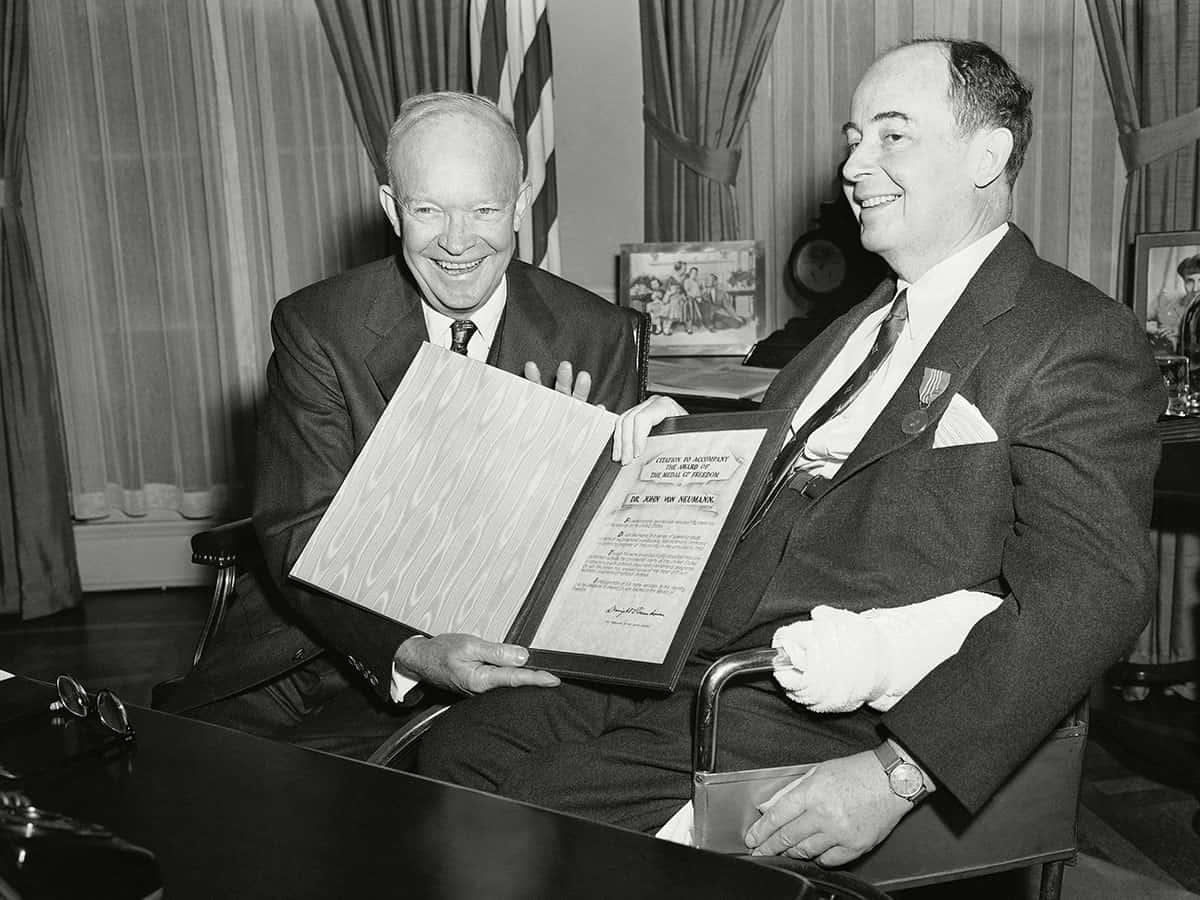
Near the end of his life, he received the Presidential Medal of Freedom from President Dwight Eisenhower.52 It doesn't get much more "well-suited" to America than the Presidential Medal of Freedom.
von Neumann was a great leader, in both academic and military contexts.
He was a good husband and father, yet was once divorced. His daughter, Marina von Neumann Whitman, wrote a memoir in 2012, titled "The Martian's Daughter: A Memoir"49. "The Martians" (Hungarian: "A marslakók") were a group of prominent scientists (mostly, but not exclusively, physicists and mathematicians) of Hungarian Jewish descent who emigrated from Europe to the United States in the early half of the 20th century."16
The term "Martian" comes via Leo Szilard, who is most famous for having conceived the nuclear chain reaction (a.k.a. nuclear weapons), and who was himself Hungarian:15,16
The universe is vast, containing myriads of stars ... likely to have planets circling around them. ... The simplest living things will multiply, evolve by natural selection and become more complicated till eventually active, thinking creatures will emerge. ... Yearning for fresh worlds ... they should spread out all over the Galaxy. These highly exceptional and talented people could hardly overlook such a beautiful place as our Earth. – "And so," Fermi came to his overwhelming question, "if all this has been happening, they should have arrived here by now, so where are they?" – It was Leo Szilard, a man with an impish sense of humor, who supplied the perfect reply to the Fermi Paradox: "They are among us," he said, "but they call themselves Hungarians."16
Marina is, as her father was, intellectually brilliant and highly successful. She graduated at the top of her class at Radcliffe (now Harvard), received a PhD from Columbia, became a successful industry executive, served as a presidential economic advisor, and since 1973 has been a Distinguished Public Service Professor of Economics at the University of Pittsburgh.9 "[Marina] wrote that [her father] was very concerned with his legacy in two aspects: her life and the durability of his intellectual contributions to the world."1 In her memoir, she speaks highly of her father, who by all accounts was a good father.
von Neumann was ethnically and culturally Jewish, but more or less religiously agnostic. He was one of a long line of areligious Jewish intellectual titans. On his deathbed, he literally opted for Pascal's Wager, converted to the Roman Catholic faith, and received the Roman Catholic last rites.1 Logically minded as always, he said "So long as there is the possibility of eternal damnation for nonbelievers it is more logical to be a believer at the end."1 (Judaism doesn't have a concept of damnation.)
He escaped Hungary before the Holocaust, so defeating Nazism was personal.
He also saw the effects of Soviet-era communism kicking off next door. Ukraine, which borders Hungary, joined the USSR in 1922 while he was still living in Hungary. In fact, nearly all the Union Republics of the Soviet Union had joined the USSR by the time von Neumann left for America in 193050.
Von Neumann entered government service primarily because he felt that, if freedom and civilization were to survive, it would have to be because the United States would triumph over totalitarianism from Nazism, Fascism and Soviet Communism. During a Senate committee hearing he described his political ideology as 'violently anti-communist, and much more militaristic than the norm'.1
He was conscientious in almost all areas of his life, yet was arrested multiple times for reckless driving (including for reading a book while driving). Driving was apparently too boring. One is reminded of Richard Feynman's famous last words: "I'd hate to die twice. It's so boring."46
I think it's the variety of von Neumann's traits that makes him so fascinating. What a fascinatingly complex individual. What would the world be like if we had more von Neumanns, or all von Neumanns?
Thoughts on von Neumann, from his daughter, in Selected Letters:
Throughout much of his career, he led a double life: as an intellectual leader in the ivory tower of pure mathematics and as a man of action, in constant demand as an advisor, consultant and decision-maker to what is sometimes called the military-industrial complex of the United States. My own belief is that these two aspects of his double life, his wide-ranging activities as well as his strictly intellectual pursuits, were motivated by two profound convictions. The first was the overriding responsibility that each of us has to make full use of whatever intellectual capabilities we were endowed with. He had the scientist's passion for learning and discovery for its own sake and the genius's ego-driven concern for the significance and durability of his own contributions. The second was the critical importance of an environment of political freedom for the pursuit of the first, and for the welfare of mankind in general. I'm convinced, in fact, that all his involvements with the halls of power were driven by his sense of the fragility of that freedom. By the beginning of the 1930s, if not even earlier, he became convinced that the lights of civilization would be snuffed out all over Europe by the spread of totalitarianism from the right: Nazism and Fascism. So he made an unequivocal commitment to his home in the new world and to fight to preserve and reestablish freedom from that new beachhead. In the 1940s and 1950s, he was equally convinced that the threat to civilization now came from totalitarianism on the left, that is, Soviet Communism, and his commitment was just as unequivocal to fighting it with whatever weapons lay at hand, scientific and economic as well as military. It was a matter of utter indifference to him, I believe, whether the threat came from the right or from the left. What motivated both his intense involvement in the issues of the day and his uncompromisingly hardline attitude was his belief in the overriding importance of political freedom, his strong sense of its continuing fragility, and his conviction that it was in the United States, and the passionate defense of the United States, that its best hope lay.
-Professor Marina von Neumann Whitman, economist and John von Neumann's daughter. Pages xv–xvi.61
More quotes from Selected Letters:
Oh, France won't matter.
-von Neumann's prewar thoughts on World War II55
To conclude, I would like to mention that the importance of accelerating approximating and computing mathematics by factors like 10,000 or more, lies not only in that one might thereby do in 10,000 times less time problems which one is now doing, or say 100 times more of them in 100 times less time, - but rather in that one will be able to handle problems which are considered completely unassailable at present. I need not tell you that I shall be very gladly at your disposal at any time when you want more specific details about this subject
-von Neumann to Commodore Louis L. Strauss, on a proposal to build a computer in 1945, page 236.
I believe it was this computer: en.wikipedia.org/wiki/IAS_machine. I wonder what he would think of ChatGPT.
von Neumann considering Artificial General Intelligence in 1957:
In principle, he reasoned, there was no reason why some day a machine might not be built which not only could perform most of the functions of the human brain but could actually reproduce itself, i.e., create more supermachines like it. He proposed to present this paper at Yale, where he had been invited to give the 1956 Silliman Lectures.
-Clay Bair Jr., in Life Magazine, 25 February 1957
That's von Neumann on artificial general intelligence and even AI superintelligence, in 1956!
von Neumann's mentality can't be easily characterized monofactorially, but this description is pretty good:
The unifying theme in von Neumann's life and work—abundantly demonstrated by his correspondence—was an insatiable urge to be absorbing information and solving problems all the time. "Johnny's most characteristic trait was his boundless curiosity about everything and anything, his compulsive ambition to know, to understand any problem, no matter on what level," wrote Klari [von Neumann's wife] after his death. "Anything that would tickle his curiosity with a question mark, he could not leave alone; he would sulk, pout, and be generally impossible until, at least to his own satisfaction, he had found the right answer."2
A mind in love with the truth.
The Silliman Lectures
The Silliman Memorial Lectures are an annual hosted lecture series at Yale University.6Von Neumann was invited to deliver the Silliman Lectures on The Computer and the Brain in the spring of 1956.6
The notes for the Silliman Lectures form the basis for von Neumann's final book, published posthumously and also named The Computer and the Brain41.
In 1955, a tumor was discovered near von Neumann's collarbone. Cancer was then found elsewhere in his body. In the spring of 1956, he checked into Walter Reed National Military Medical Center as a cancer patient. He continued to work from his hospital room, including by consulting with top military officials.3
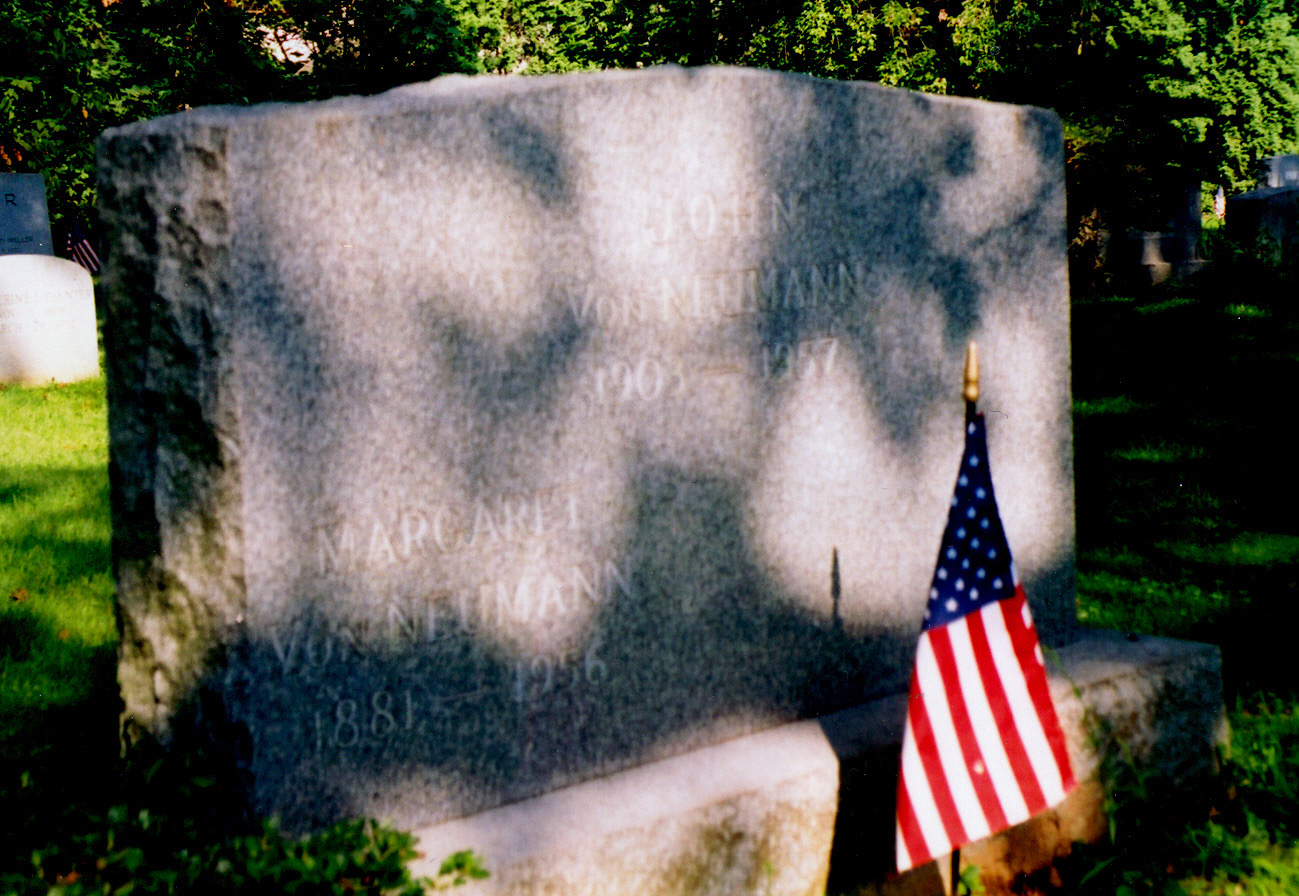
von Neumann took with him to the hospital the manuscript he was preparing for the Silliman Lectures. It was his singular professional focus during his final days.6 It was during that hospital visit, at Walter Reed National Military Medical Center, that von Neumann passed away—from bone cancer—in early 1957.
Towards the end, as cancer got hold of him and just before he received in 1956 a Medal of Freedom from President Dwight Eisenhower for his technical contributions to national defence, von Neumann asked in an article in Fortune magazine, "Can we survive technology?" The article was naturally preoccupied with the destructive potential of more powerful weapons, faster computers and more rapid telecommunications. But it presciently noted the climatic impact of rising carbon-dioxide emissions, too. Von Neumann favoured introducing new geo-engineering technologies, which he thought would unite nations more than the threat of nuclear war. Yet he accepted that there was no "complete recipe" for avoiding human extinction by technological means. "We can specify only the human qualities required," he wrote, "patience, flexibility, intelligence."8
Rest in peace, Dr. von Neumann. We have the watch.
Sources:
1 : https://en.wikipedia.org/wiki/John_von_Neumann (source of information and quotations that are not cited as being from a different source)
2 : https://www.ams.org/notices/200706/tx070600724p.pdf
3 : https://cs.stanford.edu/people/eroberts/courses/soco/projects/1998-99/game-theory/neumann.html
4 : https://en.wikipedia.org/wiki/List_of_things_named_after_John_von_Neumann
5 : https://en.wikipedia.org/wiki/File:John_von_neumann_tomb_2004.jpg
6 : https://mathshistory.st-andrews.ac.uk/Extras/Von_Neumann_Silliman
7 : https://en.wikipedia.org/wiki/G%C3%A1bor_Szeg%C5%91
8 : https://physicsworld.com/a/brilliant-polymath-troubled-person-how-john-von-neumann-shaped-our-world/
9 : https://en.wikipedia.org/wiki/Marina_von_Neumann_Whitman
10: http://repository.edulll.gr/edulll/retrieve/11419/3608_1.49_%CE%91%CE%9D_18_6_12.pdf (see the paper titled "Turing and von Neumann's Brains and their Computers", by Sorin Istrail and Solomon Marcus)
11: https://www.sciencedirect.com/topics/computer-science/von-neumann-architecture
12: https://en.wikipedia.org/wiki/ENIAC
13: https://www.startribune.com/the-man-behind-major-advances-in-atomic-energy-open-source-ai-and-game-theory/600267304/
14: https://en.wikipedia.org/wiki/Institute_for_Advanced_Study
15: https://en.wikipedia.org/wiki/Leo_Szilard
16: https://en.wikipedia.org/wiki/The_Martians_(scientists)
17: https://www.privatdozent.co/p/the-unparalleled-genius-of-john-von-beb
18: https://en.wikipedia.org/wiki/Technological_singularity
19: https://en.wikipedia.org/wiki/John_von_Neumann#/media/File:JohnvonNeumann-LosAlamos.gif
20: https://www.goodreads.com/quotes/10039869-i-have-known-a-great-many-intelligent-people-in-my
21: https://sites.math.rutgers.edu/~zeilberg/GeniusRoute.html
22: https://www.ias.edu/von-neumann
23: https://en.wikipedia.org/wiki/Timsort
24: https://www.pppl.gov/
26: https://performativebafflement.substack.com/p/john-von-neumann
27: https://mathworld.wolfram.com/OrdinalNumber.html
28: By Max-Planck Institut für Plasmaphysik - Max-Planck Institut für Plasmaphysik, CC BY 3.0, https://commons.wikimedia.org/w/index.php?curid=24388371
29: https://en.wikipedia.org/wiki/Stellarator
30: https://en.wikipedia.org/wiki/Princeton_University
31: By Photo: Andreas Praefcke - Self-photographed, CC BY 3.0, https://commons.wikimedia.org/w/index.php?curid=2238823
32: By popejon2 from Paddington, Australia - Princeton, CC BY 2.0, https://commons.wikimedia.org/w/index.php?curid=24659329
33: By Christina Keddie - Own work, CC BY-SA 4.0, https://commons.wikimedia.org/w/index.php?curid=40901849
34: https://en.wikipedia.org/wiki/Von_Neumann_architecture
35: https://press.princeton.edu/books/hardcover/9780691178561/
36: https://en.wikipedia.org/wiki/Eugene_Wigner
37: https://en.wikipedia.org/wiki/Von_Neumann_entropy
38: https://en.wikipedia.org/wiki/Quantum_logic
39: https://en.wikipedia.org/wiki/EDVAC
40: https://en.wikipedia.org/wiki/First_Draft_of_a_Report_on_the_EDVAC
41: https://en.wikipedia.org/wiki/The_Computer_and_the_Brain
42: https://dante.princeton.edu/cgi-bin/dante/DispPoemByTitle.pl?LINE=19-75&SECT=xviii.&TITLE=Purg
43: https://en.wikipedia.org/wiki/Georg_Cantor
44: https://www.lindahall.org/about/news/scientist-of-the-day/john-von-neumann/
45: https://twitter.com/Ananyo/status/1722282580018692417
46: https://www.goodreads.com/quotes/341086-i-d-hate-to-die-twice-it-s-so-boring
47: https://www.freaktakes.com/p/john-von-neumann-a-strange-kind-of
49: Whitman, M. von N. (2012). The Martian's daughter: A memoir. University of Michigan Press.
50: https://en.wikipedia.org/wiki/Republics_of_the_Soviet_Union
51: Tietz, J. (2011, December 8). Santiago's brain. Rolling Stone, (1145 100), 78–87.
52: https://physicsworld.com/a/brilliant-polymath-troubled-person-how-john-von-neumann-shaped-our-world/
53: https://ananyo.substack.com/p/oppie-and-johnny-best-frenemies-of
55: https://stem.elearning.unipd.it/pluginfile.php/512097/mod_resource/content/0/John%20von%20Neumann%20-%20Wikipedia%20copy.pdf (page 5)
56: https://albert.ias.edu/entities/archivalmaterial/ee5cb268-94ef-48e9-a231-b7b819fb7f84
57: https://www.davidsonacademy.unr.edu/blog/gifted-student-characteristics/
59: https://en.wikipedia.org/wiki/Albert_Einstein
60: https://eu.36kr.com/en/p/3646189182848648
61: Miklós Rédei. (2017). John von Neumann: Selected letters. AMS.
62: https://www.davidsongifted.org/gifted-blog/iq-and-educational-needs/
63: https://en.wikipedia.org/wiki/G%C3%B6del%27s_incompleteness_theorems
64: By Los Alamos National Laboratory - https://about.lanl.gov/history-innovation/badges/, Attribution, https://commons.wikimedia.org/w/index.php?curid=133822688