Living Forever Could Be Nice
Last summer, I was thinking about longevity research while driving around Maine looking at land for sale.
Below is a positive thought that came to mind.
I think when we cure aging, it'll be emotionally similar to what people experience when they reach absolute financial freedom.
Years ago, I read about a woman who hit her financial freedom goal. The goal was something like a net worth of $7 million.
She described it as unbelievable joy, freedom, and lightness. She said that, if anything, the experience is underrated.
As with the old trope that "money isn't important", what we wish were true (that she felt nothing) couldn't be further from the truth.
Also interesting was what happened after she achieved financial freedom. She said her wealth grew faster afterward. She worked more in alignment with her personal missions, took more calculated risks, and so on.
I think the ability to live as long as one likes will be similar. I think the potential downsides, such as logistical problems, are oversold. Humans are good at problem-solving...usually once the problem is imminent.
Imagine if Eratosthenes, Euler, Edison, Einstein, Noether, von Neumann, da Vinci, Tesla, and Isambard Kingdom Brunel were all alive and well. Each would have a career hundreds, or thousands, of years long. We might be Kardashev Type-II or Type-III already.
On a personal level, to put it poetically, 100 normal-length lifetimes should really be the bare minimum. I once saw someone remark upon a biographical film, about a man in his 80s who had lived an amazing life, that people like that ought to be able to start over and live another lifetime.
I'd like a total of at least 30 lifetimes, or so. Let's say a PhD, then teaching and original research, in each of so many fields. Mathematics, history (a few times over for good coverage of world history), psychology, computing - and artificial intelligence specifically, religion, biology, philosophy, medicine, sociology, literature, and more. A few lifetimes for fluency in at least one language in each major language family. Let's say the Indo-European, Sino-Tibetan, Atlantic–Congo, Afroasiatic, Austronesian, and Dravidian language families to start⁶. The rest for putting it all to use: developing vaccines, discovering mathematics, building businesses, exploring the universe - literally and through scientific discovery, speaking languages, connecting with people, building relationships.
I thought to live
Two centuries, or three-
Yet here comes death
To me, a child
Just eighty-five years old.
― Hanabusa Ikkei, Japanese artist (died in 1843)⁷
In longevity research, there's the idea of "longevity escape velocity". That's living long enough to "catch the train" of scientific progress such that one ultimately achieves immortality². "[I]n a given year in which longevity escape velocity would be maintained, medical advances would increase people's remaining life expectancy more than the year that just went by"². I don't think longevity escape velocity, the possibility of curing aging entirely, and so on, are necessarily millenarian.
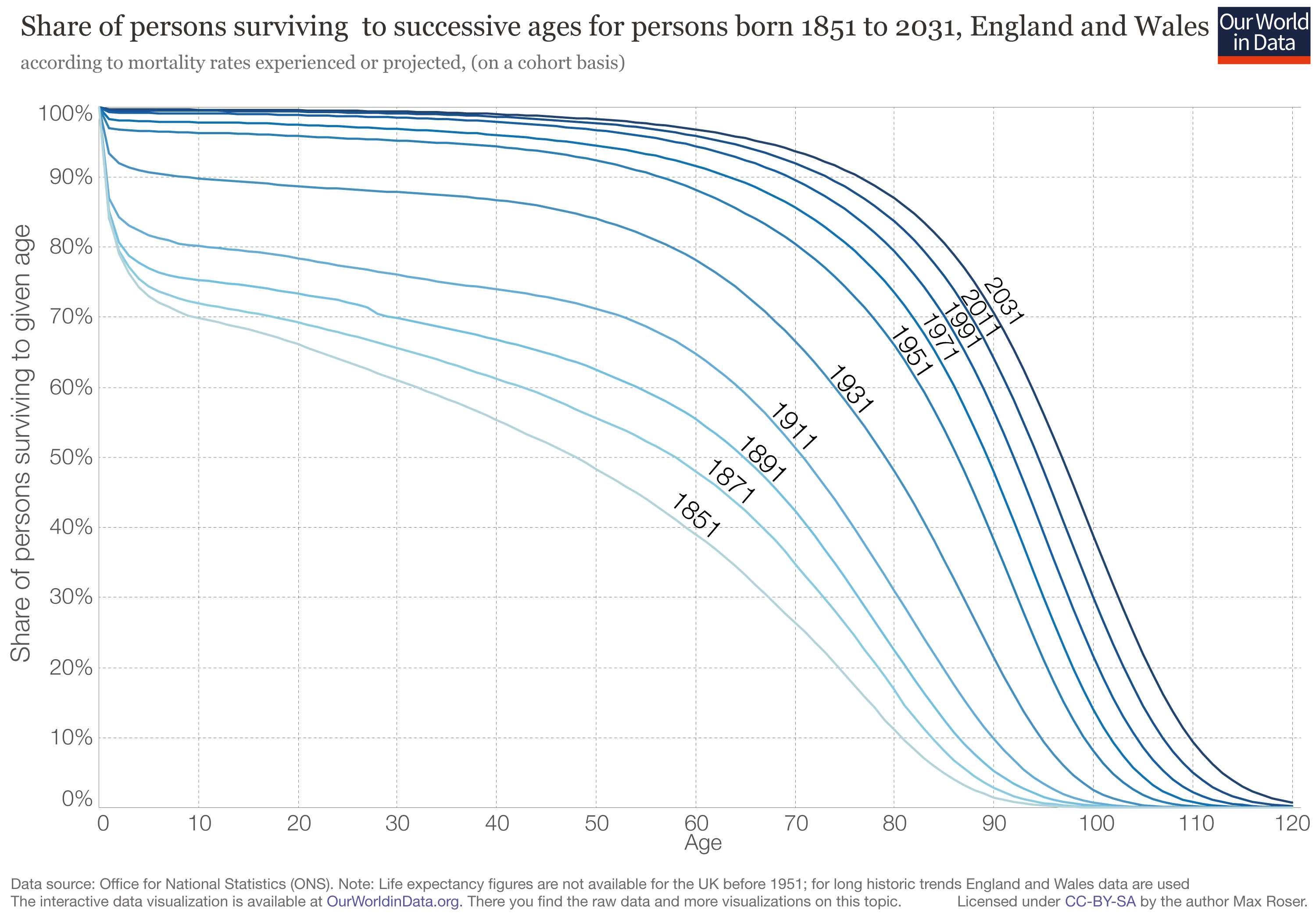
The image at the top of this post shows the anchoring effect humans currently experience: the maximum age is stuck around 120 years. However, there's been effective research in extending the lifespan of lab animals and, for the first time in 2019, in humans³. In a 2019 study led by Dr. Greg Fahy, treatment with recombinant human growth hormone (rhGH) caused the cellular age of participants to be "approximately 1.5 years less than baseline after 1 year of treatment"³.
The anchoring around 120 years appears to be due to the Hayflick limit. The Hayflick limit is the number of times a human cell can divide. Once you hit the limit, the cell stops dividing, the tissue starts to die, and so does the person.⁴ It's like a candle burning through its wax.
I think artificial intelligence can help solve this.
Hydras, the small freshwater sea creatures, are cellularly immortal.⁵
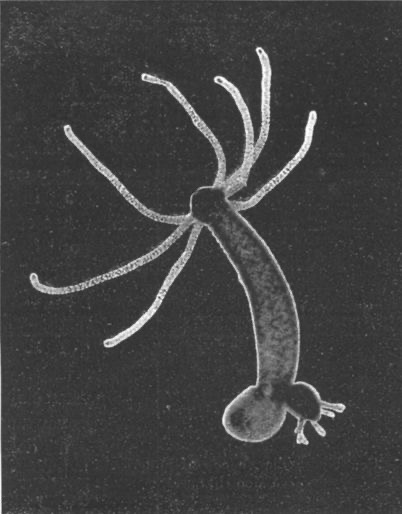
Hydras do not die of old age, and in fact do not age at all.⁵ They have an unlimited capacity to reset their cells to a "fresh" state.⁵
"Research today appears to confirm Martinez' study. Hydra stem cells have a capacity for indefinite self-renewal. The transcription factor "forkhead box O" (FoxO) has been identified as a critical driver of the continuous self-renewal of Hydra."⁵
So, Hydras prove it's possible. I think it'd be nice.
Sources:
¹: https://ourworldindata.org/life-expectancy-how-is-it-calculated-and-how-should-it-be-interpreted
²: https://en.wikipedia.org/wiki/Longevity_escape_velocity
³: https://gwern.net/doc/longevity/epigenetics/2019-fahy.pdf
⁴: https://en.wikipedia.org/wiki/Hayflick_limit
⁵: https://en.wikipedia.org/wiki/Hydra_(genus)
⁶: https://en.wikipedia.org/wiki/List_of_language_families
⁷: https://michaelstoneteaching.com/notes-on-dying-3-death-poems/